Shopify Store Traffic Generation Strategies That Work in 2026
No-fluff breakdown of the exact traffic strategies Shopify stores rely on in 2026: SEO, paid ads, email, social, content, influencers and technical setup.
Dec 29, 2025



Facebook ads provide a cost-effective way to test business ideas by targeting specific audiences with minimal budget. Entrepreneurs can validate demand, test messaging, and gather real market data for as little as $20-100 before building a full product.
Most startup ideas won't survive contact with real customers. According to Nexford's guide on idea validation, the cold reality is that most early-stage ideas won't survive the rigors of the real world. That's precisely why idea validation matters—it separates visionary concepts from those doomed for failure.
Facebook ads offer something remarkable: the ability to test market demand without building the product first. Instead of investing months and thousands of dollars, entrepreneurs can gauge interest, refine messaging, and identify the right audience for under $100.
This approach aligns with lean startup principles that emphasize testing assumptions quickly and cheaply. The goal isn't to generate sales immediately—it's to gather evidence that people actually want what you're planning to build.
Facebook's advertising platform reaches billions of users with sophisticated targeting capabilities. But the real power lies in speed and cost efficiency.
Traditional market research takes weeks or months. Focus groups cost thousands. Facebook ads deliver data in days for a fraction of the cost. The platform allows entrepreneurs to target specific demographics, interests, behaviors, and even competitor audiences.
Here's what makes Facebook ads particularly effective for validation:
The testing process reveals not just whether people click, but who clicks. That demographic data becomes invaluable for future product development and marketing strategies.

Before a campaign launches, the first real decision is which creative is worth putting budget behind. Extuitive is built for that step. It predicts likely ad performance before launch using AI models validated against live campaign results. For teams weighing different ad options, it gives a clearer way to compare creative before anything goes live.
Use Extuitive to:
👉 Book a demo with Extuitive to see how it predicts ad performance before launch.
Effective validation testing requires clear goals and structured experimentation. The setup phase determines whether the results will actually be useful.
Before spending a dollar, establish clear validation criteria. What metrics will prove the idea has potential?
Common validation benchmarks include:
According to community discussions on startup forums, if cost per click falls below 50 cents but no conversions appear after a hundred visitors, it's time to re-evaluate the value proposition or landing page design.
The landing page doesn't need to be elaborate. It needs to clearly communicate the value proposition and capture interest.
Essential elements include:
The page serves as a proxy for the product itself. People who've interacted with pre-launch landing pages are more likely to convert when the product launches, even if they didn't initially sign up.
Before creating ads, investigate what competitors are already doing. Facebook's Ad Library provides transparency into active campaigns.
Search for competitors or related businesses in the Ad Library to see:
This competitive intelligence reveals gaps in messaging or oversaturated angles. If five competitors emphasize price, consider emphasizing quality or convenience instead.
The goal isn't to copy competitors—it's to understand the current market conversation and find differentiation opportunities.
Validation ads differ from sales ads. The focus shifts from conversion to engagement and interest measurement.
The ad copy should directly address the problem while hinting at the solution. Keep it concise—most users scroll quickly.
Effective validation ad structure:
Avoid jargon. Use language the target audience actually uses when describing their problems. According to Harvard Business School's course on Launching Tech Ventures, experimenting and iterating on a precise definition of the target customer is critical for product-market fit.
Visual content drives engagement on Facebook. Testing different image styles reveals which resonates with the target audience.
Run multiple ad variations simultaneously to see which visual approach generates better engagement. The winning visual often indicates which aspect of the value proposition matters most to potential customers.
Precise targeting determines whether ads reach people likely to have the problem being solved.
Start with focused audience parameters rather than broad targeting. Narrow audiences provide clearer signals about whether the core target market responds positively.
Build initial test audiences using these approaches:
Test 2-3 distinct audiences rather than one broad group. Differences in engagement across audiences reveal which segments find the concept most compelling.
Geographic targeting matters too. Testing in smaller markets (specific cities or regions) stretches limited budgets further while still providing meaningful data.
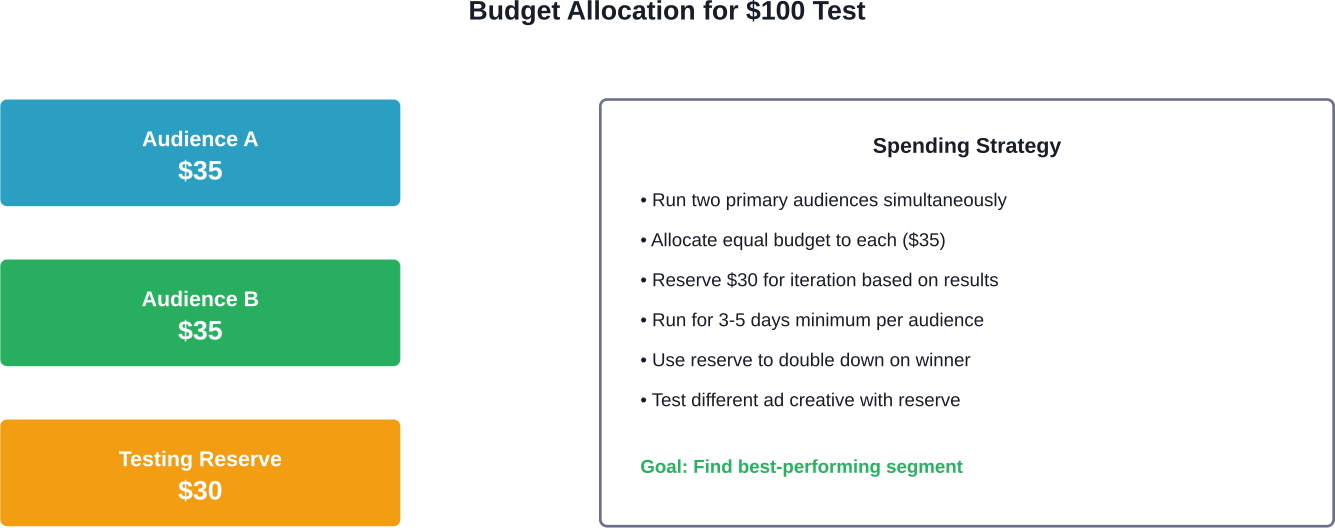
With ads created and audiences defined, launch the campaign with a clear timeframe. Most validation tests run 3-7 days depending on budget.
Set daily budget limits rather than lifetime budgets for better control. This prevents Facebook from spending the entire budget in the first day if the audience responds strongly.
Monitor these metrics daily:
Don't panic if the first 24 hours show weak performance. Facebook's algorithm needs time to optimize delivery. Real patterns emerge after 48-72 hours.
Data only becomes valuable when it informs decisions. The analysis phase determines whether to proceed, pivot, or abandon the idea.
Look for patterns across multiple metrics rather than focusing on single numbers.
Strong validation signals include:
Weak signals that suggest problems:
The Federal Trade Commission emphasizes that advertising must be truthful and non-deceptive, with evidence to back up claims. This principle applies to validation testing too—measure what's real, not what's hoped for.
Pay attention to who actually engaged versus who was targeted. Unexpected demographic patterns often reveal better market opportunities.
If the target audience was 25-35 year old professionals but most engagement came from 45-55 year olds, that's valuable data. Either the messaging appeals to a different segment, or the original target was wrong.
Geographic patterns matter too. Strong response from specific cities or regions might indicate where to launch first or where demand concentrates.
The first test rarely provides perfect clarity. Iteration refines understanding and improves validation confidence.
If results show promise but not overwhelming validation, test variations:
Each iteration should test one variable at a time. Changing multiple elements simultaneously makes it impossible to know what drove different results.
Many experts suggest running at least two rounds of testing before making final decisions. The first round identifies potential; the second round confirms it.
Testing can become procrastination if it continues indefinitely. At some point, validation evidence either supports moving forward or it doesn't.
Consider validation complete when:
If 2-3 rounds of testing with different approaches all show weak results, that's validation too—validation that the market doesn't want this solution or that positioning hasn't been found yet.
According to University of San Diego's guidance on lean startups, entrepreneurs must consider the challenges of survival in today's competitive market. Validation testing provides evidence before committing resources to those challenges.
Facebook ads democratize market validation. Entrepreneurs no longer need massive budgets to test whether customers want what they're planning to build.
The approach works because it prioritizes evidence over assumptions. Rather than building for months and hoping customers appear, testing validates demand first. That sequence dramatically reduces risk.
But here's the thing—validation testing only works if entrepreneurs accept the results honestly. Strong signals mean proceed. Weak signals mean pivot or stop. Ignoring negative data and building anyway defeats the entire purpose.
The businesses that succeed are those that validate early, iterate based on real market feedback, and build only after confirming people actually want the solution. Facebook ads make that process accessible to anyone willing to invest a small budget and interpret the data objectively.
Ready to test your business idea? Create a simple landing page, define your target audience, allocate $50-100 for testing, and let real market data guide your next steps. The insights gained in one week of testing often exceed months of speculation.


