Jobs Safe From AI in 2026: A Practical Guide
Discover which careers AI can't replace. From nurses to electricians, learn what makes jobs automation-resistant with data from BLS and recent studies.
Apr 16, 2026



AI agents are transforming ecommerce in 2026 through autonomous shopping assistants that handle discovery, negotiation, and purchases on behalf of consumers. Major retailers and tech companies like Google, Salesforce, and Shopify have launched new protocols and platforms to support agentic commerce, while enterprises rapidly deploy AI agents from pilots to production. Federal regulators are simultaneously cracking down on misleading AI business opportunity claims to protect merchants and consumers.
The ecommerce landscape is experiencing its most significant shift since the introduction of mobile shopping. AI agents—autonomous software programs that can research products, negotiate prices, and complete purchases without constant human oversight—are moving from experimental pilots to mainstream adoption across retail.
And it's happening faster than most industry watchers predicted.
This transformation isn't just theoretical. Major tech companies have launched new infrastructure to support agentic commerce, retailers are reporting measurable returns, and regulatory bodies are stepping in to ensure consumer protection. Here's what's happening right now in the world of AI agents and ecommerce.
Google announced the Universal Commerce Protocol (UCP) in January 2026 at the National Retail Federation conference, marking a pivotal moment for standardized AI agent shopping. Developed in collaboration with Shopify, Etsy, Wayfair, Target, and Walmart, the protocol enables AI agents to work seamlessly across different stages of the customer buying process.
The core idea? Instead of requiring separate connections with every retailer, UCP provides a standardized framework that facilitates discovery, purchase, and post-purchase support. Think of it as a common language that allows any AI agent to interact with participating retailers without custom integrations for each one.
But Google didn't stop there. In September 2025, Google announced the Agent Payments Protocol (AP2), backed by more than 60 merchants and financial institutions. AP2 focuses specifically on purchase transactions initiated by AI agents, creating an interoperable system between AI platforms, payment processors, and vendors.
The protocol maintains an auditable trail for every transaction—critical for fraud prevention and dispute resolution when autonomous agents are making purchases on behalf of consumers.

Not every AI company in ecommerce is building autonomous shopping assistants or enterprise agent platforms. Some are focusing on a different part of the workflow - the decisions brands make before campaigns ever go live. Extuitive is one example. Its platform is built around forecasting ad performance before launch, helping ecommerce teams predict which creatives are more likely to perform and which ones may fall flat before budget gets committed.
That points to a broader shift in the market. AI in ecommerce is not only changing how shoppers discover and buy products. It is also changing how merchants decide what to test, promote, and scale in the first place. As more brands look for ways to reduce wasted spend and move faster on creative decisions, tools like Extuitive show how agent-style automation is starting to shape the demand side of ecommerce as well.
While Silicon Valley debates whether we're in an AI bubble, Salesforce quietly demonstrated that enterprise AI agents are generating real revenue. The company's Agentforce platform added 6,000 new customers in a single quarter—a 48% increase that brought total customers to 18,500 enterprises.
That's not hype. That's adoption.
Sameer Hasan, Chief Technology and Digital Officer at Williams-Sonoma Inc., emphasized the importance of policy compliance systems when deploying agents at scale. According to executives quoted in coverage of the announcement, enterprises need dedicated systems checking toxicity, grounding, security, and privacy on every agentic activity before rolling out agents company-wide.
The numbers back up the enthusiasm. Salesforce reported hitting $540 million in revenue from Agentforce, challenging narratives about AI being all promise and no delivery.
CrewAI's "2026 State of Agentic AI" report surveyed 500 senior executives and found something remarkable: every single respondent reported their enterprise was already using AI agents in some capacity. Not planning to use them. Using them now.
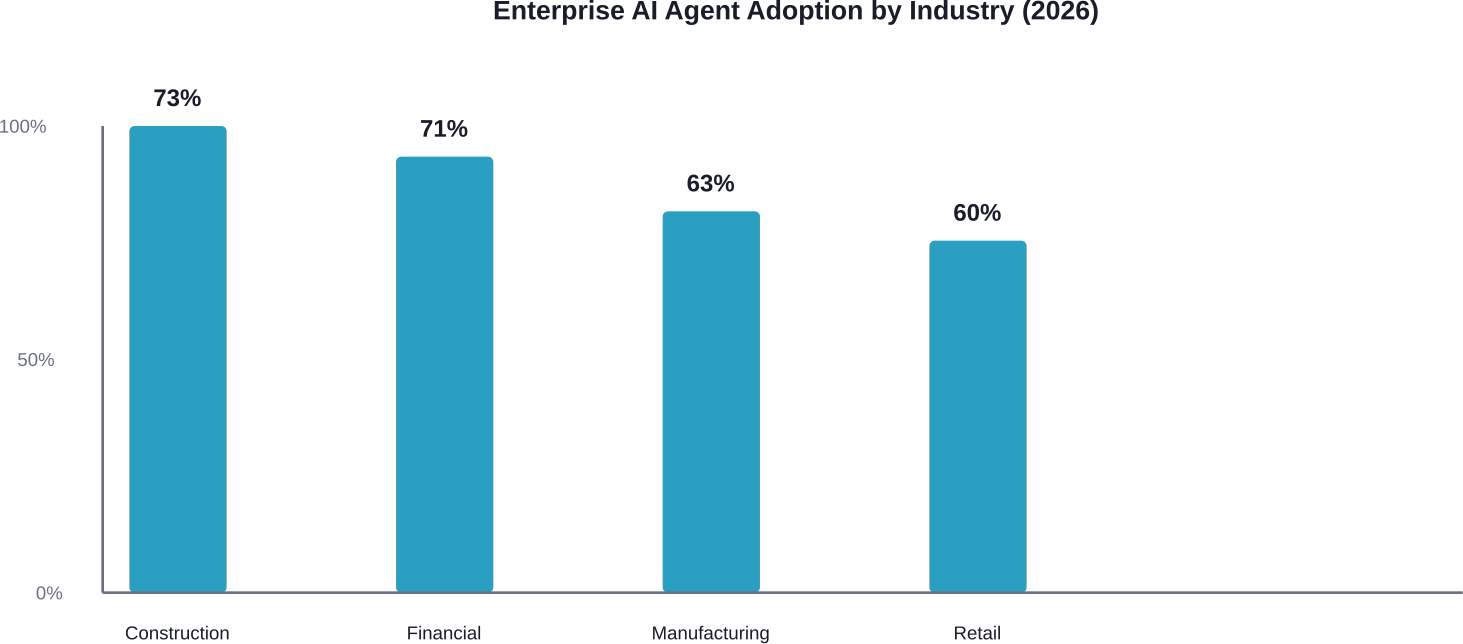
This preference for extensibility and open-source foundations is especially strong across industries:
Another survey found that 65% of enterprises are already deploying AI agents today, with 81% reporting that adoption is either fully scaled or actively expanding. Security, integration, and reliability emerged as the top concerns as businesses move beyond proof-of-concept projects.
Here's the thing though—enterprises aren't just testing these systems anymore. They're embedding AI agents into core business workflows for customer support, product recommendations, inventory management, and order processing.
Real-world performance data is starting to emerge, and the numbers are compelling. Constructor's AI Shopping Agent (ASA) delivered a 10% lift in website revenue, a 6% boost in search conversions, and a 7% increase in click-through rate for participating retailers.
These aren't marginal improvements. For high-volume ecommerce sites, a 10% revenue lift translates to millions in additional sales.
So what makes AI agents different from traditional chatbots? They operate autonomously within pre-defined parameters. Instead of waiting for a customer to ask questions, agents can proactively search products, compare options, negotiate prices, and complete transactions based on user preferences around price limits, brand preferences, and delivery requirements.
According to industry analysis, AI agents function as personal digital assistants that source, negotiate, and complete purchases using pre-approved payment credentials. The consumer sets the rules—"I need running shoes under $150 with good arch support"—and the agent handles the research and transaction.
IDC estimates that over 50% of enterprise applications already use embedded AI assistants or advisors, with about 20% enhanced with fully autonomous AI agents. Gartner predicts continued acceleration in this space throughout 2026.
Online returns represent a massive financial drain on retailers. The U.S. National Retail Federation estimated that 15.8% of annual retail sales were returned in 2025, totaling $849.9 billion. For online sales specifically, that number jumped to 19.3%.
Virtual try-on technology powered by AI is emerging as one solution. By allowing customers to visualize fit and style before purchasing, retailers hope to reduce returns caused by sizing issues and unmet expectations. The returns problem has become solvable now due to advancements in AI that allow firms to run visuals for end users cheaply enough to scale.
But wait. Does virtual try-on actually work, or is it just another tech gimmick?
The technology has improved dramatically. Earlier avatar systems looked acceptable for a few seconds but quickly fell into the uncanny valley during interaction. As one developer noted, "They look good for a few seconds, and as soon as you start interacting with them, it feels very uncanny."
Newer systems like Lemon Slice-2 use diffusion models to create digital avatars from a single image. The company raised $10.5 million from Y Combinator and Matrix Partners to build out technology that adds a video layer to AI chatbots, creating more realistic customer service interactions.
Not all AI ecommerce news is positive. According to the Federal Trade Commission, enforcement actions have targeted companies making false promises about AI-powered business opportunities.
In March 2026, Air AI and its owners were banned from marketing business opportunities as part of an FTC settlement. The agency charged that the company misled entrepreneurs and small businesses about the capabilities and earning potential of their AI systems.
This followed similar action in June 2024 against FBA Machine and Bratislav Rozenfeld, who allegedly guaranteed consumers could make money operating online storefronts using AI-powered software. The defendants faced charges for making false income claims in what the FTC characterized as a business opportunity scheme.
The message from regulators is clear: companies can't make unsubstantiated claims about AI capabilities or earning potential. The FTC has brought legal actions against organizations that violated consumer privacy rights, failed to maintain security for sensitive information, or caused substantial consumer injury through deceptive AI marketing.
OpenAGI emerged from stealth in December 2025 with Lux, a foundation model designed to operate computers autonomously by interpreting screenshots and executing actions across desktop applications. The MIT spinout claimed its system scored 83.6% on the Online-Mind2Web benchmark, compared to 61.3% for OpenAI's Operator—at one-tenth the cost.
The benchmark tests agents in live online environments where pages change dynamically and unexpected obstacles appear, providing a more realistic assessment than cached website tests. According to researchers, the results "paint a very different picture of the competency of current agents."
This matters for ecommerce because effective computer control is foundational for AI agents that need to navigate diverse retailer websites, handle checkout processes, and manage account settings across platforms.
Academic research is providing frameworks for more sophisticated ecommerce agents. The Facebook Marketplace Assistant (FaMA) architecture, detailed in recent arXiv research, demonstrates how conversational AI can provide a more accessible alternative to traditional app interfaces for managing marketplace activities.
Other research explored using LLM agents as "digital twins" to simulate customer behavior and evaluate shopping assistants. While agents captured the broad structure of human-AI interaction, trajectory analysis showed significant divergence—sequence-level similarity remained below 0.2, with only about 2% of agent-human pairs choosing the same product.
The takeaway? AI agents can model general shopping patterns but still struggle to replicate individual consumer preferences with high fidelity. This suggests a hybrid approach—agents handling research and filtering, with humans making final decisions—may be optimal for complex purchases.
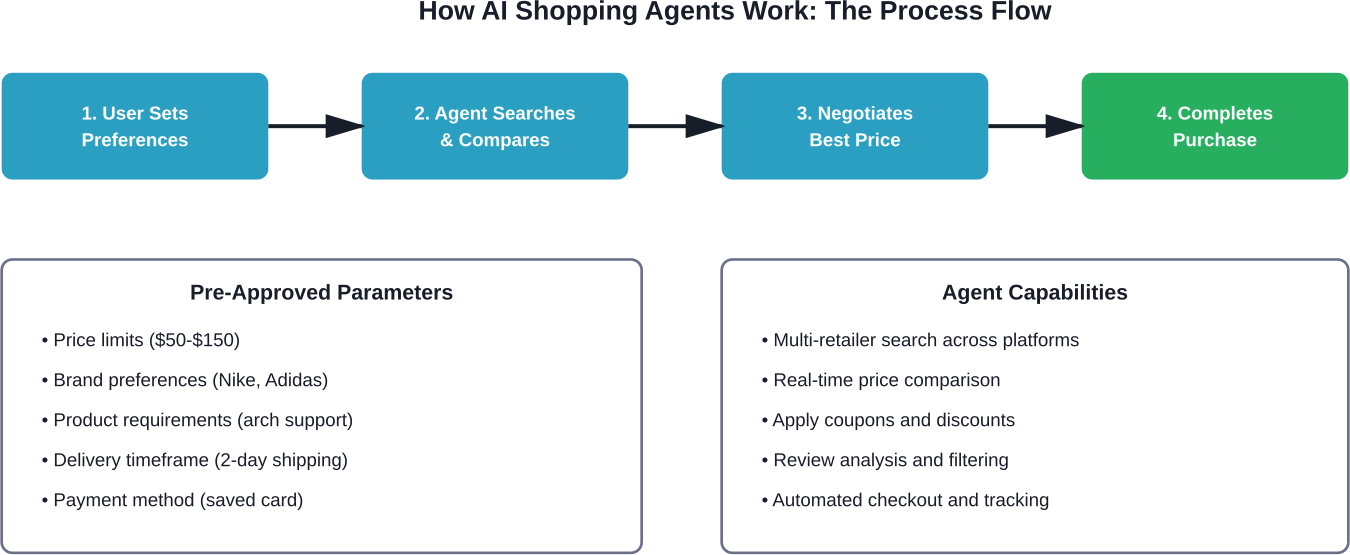
Agentic commerce represents a fundamental shift from interface innovation to decision delegation. Consumers aren't just getting better search results or chatbots—they're delegating purchasing authority to autonomous systems that operate within defined boundaries.
For retailers, this creates both opportunities and challenges. Agents could drive higher conversion rates by removing friction from the buying process. But they also commoditize products by ruthlessly optimizing for price and specs, potentially eroding brand loyalty.
The infrastructure is being built now. Google's UCP and AP2 protocols provide standardization. Payment processors are adapting systems to handle agent-initiated transactions. Retailers are implementing APIs that allow agents to access product catalogs, pricing, and inventory in real-time.
Sound familiar? It's similar to how mobile commerce emerged—first as a novelty, then as a necessity, and finally as the dominant channel for certain demographics and product categories.
The transformation is happening now, not in some distant future. Protocols are being standardized. Enterprise adoption is accelerating. Real revenue is being generated.
But challenges remain. Security and privacy need constant vigilance. Integration across legacy systems creates technical debt. And the fundamental question of how much purchasing authority consumers will delegate to autonomous agents remains unanswered.
What's clear is that retailers can't afford to wait and see. The infrastructure for agentic commerce is being built by the largest players in tech and retail. Companies that delay implementation risk being left out of emerging standards and ecosystems.
For businesses exploring AI agents, the priority should be identifying high-value use cases—customer support, product recommendations, inventory optimization—where automation delivers measurable improvements without sacrificing the human judgment that complex decisions require.
The age of agentic commerce has arrived. The question isn't whether to adopt AI agents, but how quickly you can deploy them effectively and responsibly.


