AI Tools for Marketing Analytics: Turning Data Into Real Insights
Discover how AI tools are reshaping marketing analytics, from smarter insights to faster decisions and more confident campaigns.
Jan 7, 2026



Shopify powers millions of online stores, but its own location is surprisingly easy to miss. It doesn’t sit in Silicon Valley. It isn’t based in New York. And despite being a global company, it hasn’t chased the usual tech hubs.
Shopify is headquartered in Ottawa, Canada, and that choice says more about the company than it might seem at first glance. To understand where Shopify is today, it helps to start with where it began and why that location still matters.
Shopify’s official headquarters is located in Ottawa, Ontario, Canada.
While 150 Elgin Street was Shopify’s iconic home for years, the company officially vacated that space in 2020 following its 'Digital by Default' shift. As of 2026, Shopify's registered head office address is 151 O'Connor Street, Ground Floor, Ottawa. The former Elgin Street headquarters has since been converted into a multi-tenant collaboration and coworking center.
That said, Shopify is no longer organized around a single physical office. It operates as a remote-first company, with employees spread across Canada and many other countries.
Ottawa is still the headquarters. It just is not the center of gravity anymore.
Shopify did not start as a polished tech company with a grand headquarters plan. It started as a practical solution to a problem.
The founders were running a small online snowboarding store and could not find software that did what they needed. So they built their own. That decision, made in Ottawa, eventually turned into Shopify.
Choosing to stay in Ottawa was not accidental. At the time, it was not a fashionable tech city. But it offered something valuable: access to engineering talent, lower operating costs than major US hubs, and room to grow without pressure to conform to Silicon Valley norms.
That early environment shaped Shopify’s identity. The company grew with a strong product focus and a tendency toward independence. Being outside the usual tech spotlight allowed it to move deliberately and avoid some of the noise that follows trend-driven companies.
Ottawa became part of Shopify’s DNA, not just its mailing address.
For many years, Shopify’s office at 150 Elgin Street was a genuine center of activity. Teams worked together there across engineering, product, operations, leadership, and support functions.
The office itself became known for its unconventional layout and employee-focused design. It reflected a broader tech industry trend at the time: offices as creative spaces, not just rows of desks.
But more importantly, it served a functional role. It was where decisions were made, where collaboration happened in person, and where company culture was reinforced daily.
That role began to change well before remote work became widespread.
In 2020, Shopify made a decisive move. It announced that it would become a digital by default company. In simple terms, that meant most employees would no longer be expected to work from a physical office.
This was not framed as a temporary adjustment. It was a structural change.
The company recognized that location-based work limited hiring, slowed teams down, and created unnecessary friction. Moving to a remote-first model allowed Shopify to recruit talent across geographies and give teams more autonomy over how they worked.
Ottawa did not stop being the headquarters. But it stopped being the place where work had to happen.
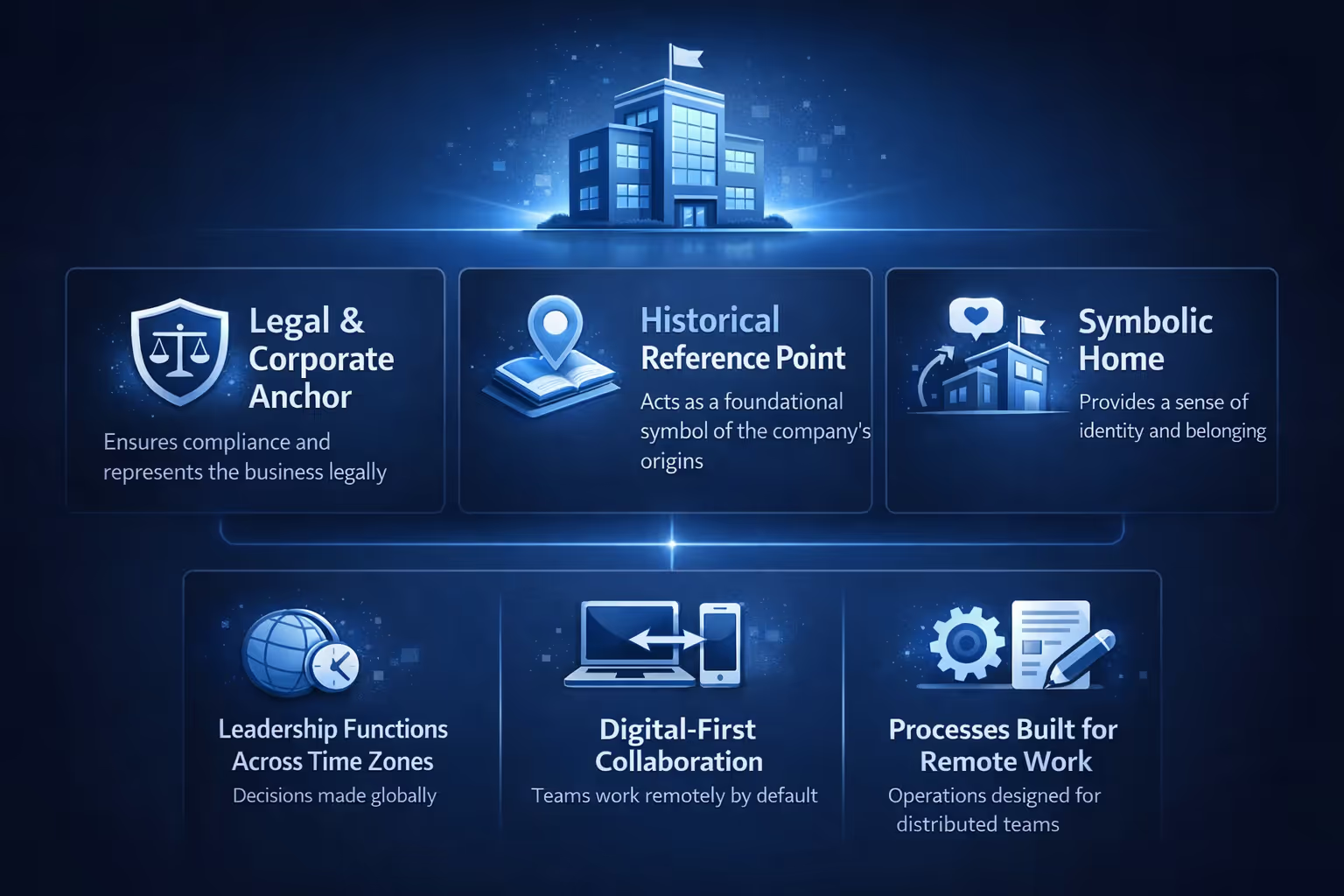
In traditional companies, headquarters usually serve three purposes:
Shopify no longer relies on any of those being tied to a building.
Instead, headquarters now functions as:
Leadership decisions happen across time zones. Teams collaborate digitally by default. Processes are designed assuming people are not in the same room.
This is an important distinction. Shopify did not simply allow remote work. It rebuilt its operations around it.
Shopify’s internal structure reflects its remote-first reality.
Teams are typically organized by function and mission rather than location. Engineering teams, product groups, and operational units are distributed. Collaboration happens through documentation, written updates, and scheduled discussions rather than ad hoc office conversations.
This has influenced how Shopify communicates internally. Writing matters. Clarity matters. Decisions are expected to be documented so they can be understood by people who were not present when they were made.
This approach favors careful thinking over rapid but shallow alignment.
Shopify builds tools for merchants who operate independently. Many of those merchants work outside traditional office environments themselves.
A distributed internal structure aligns with the company’s product philosophy. Shopify focuses on enabling autonomy, reducing friction, and letting users work on their own terms. That same mindset shows up internally.
Remote-first work is not treated as a perk. It is treated as a design constraint, similar to how the platform itself is designed.
Yes, but differently.
Shopify still maintains physical spaces, including in Ottawa. These spaces are used for specific purposes such as team gatherings, planning sessions, and occasional in-person collaboration.
They are not used as daily attendance hubs. Employees are not expected to relocate or commute regularly.
In practice, offices are optional tools, not default workplaces.

Shopify employs people across Canada, the United States, Europe, and several other regions. Unlike traditional companies, it does not tie seniority, influence, or decision-making power to physical proximity to leadership. Being closer to an office or executive does not translate into more visibility or authority.
This removes an old dynamic where location quietly shapes careers. At Shopify, contribution carries more weight than geography.
Operating this way has significantly expanded Shopify’s talent pool. The company can hire strong candidates wherever they live, rather than asking them to relocate or fit into a single office culture. This has allowed teams to form around skills and experience instead of postal codes.
It also creates more flexibility for employees. People can work in environments that suit them, without sacrificing career growth or meaningful work.
A global workforce is not frictionless. Time zones do not always align. Context can be lost more easily. Informal alignment that once happened through quick conversations now requires intention.
Shopify does not pretend these challenges do not exist. Instead, it treats them as design constraints that need to be solved thoughtfully.
To make distributed work sustainable, Shopify emphasizes structure and clarity. Communication is deliberate. Expectations are written down. Decisions are documented so they can be understood by people who were not present when they were made.
This reduces dependence on constant meetings and helps teams move forward without waiting for real-time confirmation. Written decision-making becomes a shared source of truth rather than an afterthought.
In this model, the physical headquarters matters far less than the systems that connect people. Shopify runs on shared understanding, not shared space. Alignment comes from documentation, process, and trust, not from being in the same room.
For a company operating at global scale, this shift is not just practical. It is essential.
Leadership at Shopify operates in a distributed way. Executives and senior managers are not concentrated in one city.
This requires intentional design. Meetings are planned carefully. Information is shared proactively. Decisions are communicated clearly to avoid confusion.
It also means leadership is less visible in a traditional sense. There is no walking past an executive’s office. Authority comes from clarity and consistency rather than physical presence.
This suits a company that values independence and trust.
Shopify’s culture has evolved alongside its work model.
Early on, culture was reinforced through shared physical experiences. Office design, in-person events, and daily interactions played a big role.
Today, culture is reinforced through values, expectations, and how work is done. Autonomy is emphasized. Accountability is clear. Performance is measured by outcomes, not hours spent visible.
This shift is not for everyone. But for Shopify, it aligns with the type of work it does and the people it hires.
This distinction is important for anyone researching Shopify.
Legally and officially, Shopify is headquartered in Ottawa. That affects corporate filings, governance, and regulatory matters.
Operationally, Shopify functions as a distributed organization. Work happens everywhere.
Both statements are true at the same time.
For most merchants, Shopify’s headquarters location has little direct impact. What matters is platform reliability, support, and product development.
However, Shopify’s internal structure influences how quickly it can adapt, how it builds features, and how it supports users globally.
A distributed workforce allows for broader perspectives and continuous development across regions. It also means Shopify is less dependent on a single market or labor pool.
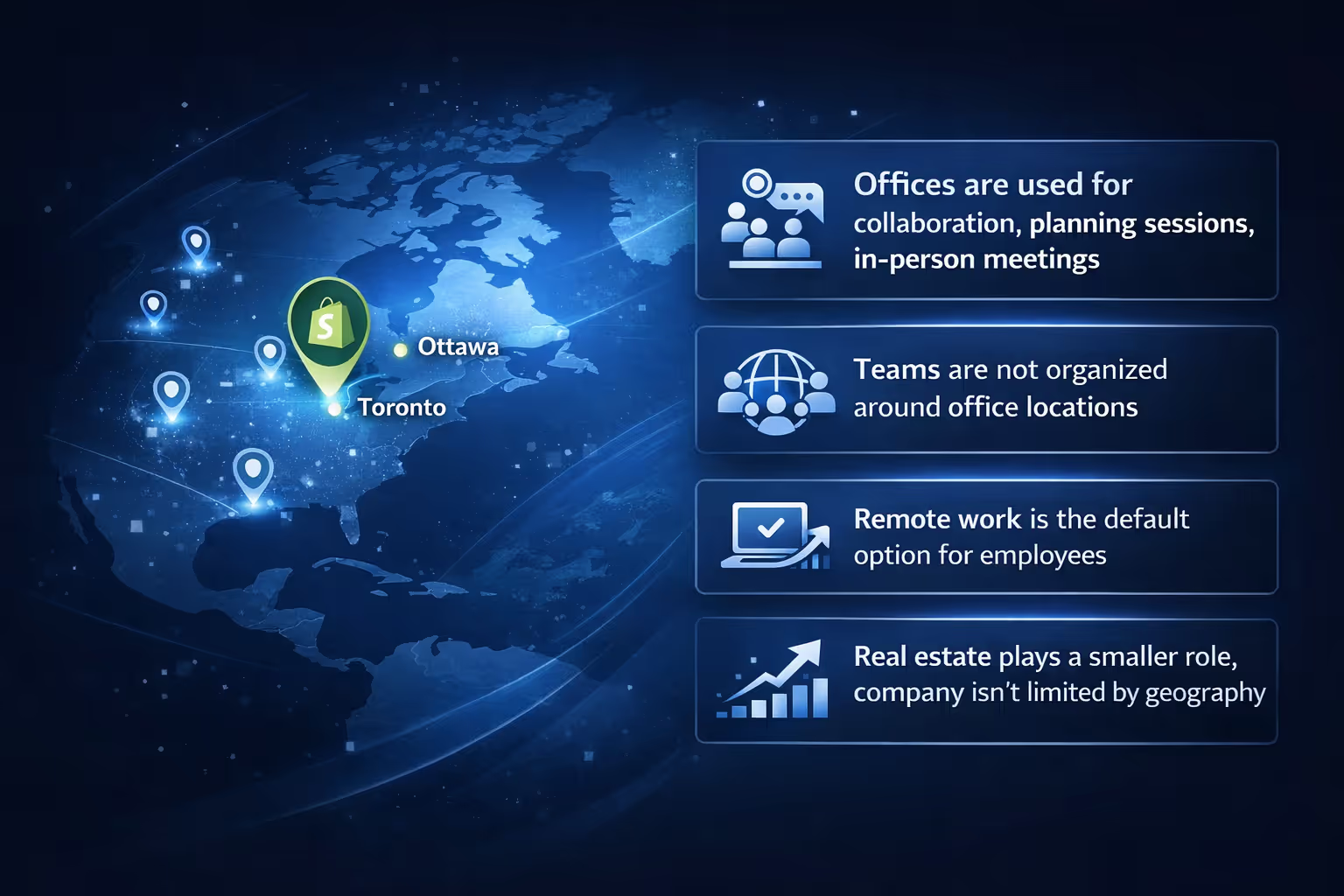
While Ottawa remains the official headquarters, Shopify has historically maintained offices and hubs in other cities, including Toronto and several international locations. Over time, the role of these spaces has shifted.
Today, physical locations serve a supporting function rather than defining how or where work happens.
This flexible approach reduces dependence on physical offices and allows Shopify to grow without tying its success to a specific city or building.
Shopify is unlikely to return to a traditional office-first model. The systems, expectations, and culture have moved beyond that.
At the same time, it is unlikely to abandon the idea of a headquarters entirely. Ottawa will likely remain the official home, even as work continues to happen globally.
This hybrid understanding of place reflects a broader shift in how modern companies operate.

Shopify’s shift to a remote-first, distributed model has changed how decisions get made. There’s less room for guesswork and less patience for slow feedback loops. Teams need clarity early, before budget and time are committed.
That’s where Extuitive comes in.
We work with Shopify merchants who want to validate ideas before launching ads at scale. Instead of relying on expensive consumer research or learning through trial and error, our AI agents let teams test messaging and creative upfront using models based on over 150,000 real consumer personas.
With Extuitive, merchants can generate ad concepts, predict purchase intent, and move to launch with more confidence. It’s a practical way to reduce uncertainty, speed up launches, and build ads that are designed to convert from day one.
Shopify is headquartered in Ottawa, Canada. That fact is simple and stable.
What has changed is how much that location defines the company’s daily life. Shopify today is built around distributed teams, written communication, and autonomy. The headquarters is an anchor, not a center.
Understanding that distinction helps make sense of how Shopify operates, hires, and builds its platform.
It is a company with a clear home and a global way of working. And that combination is very much intentional.


