Top Facebook Ads Agencies Austin: A Local Guide to Paid Social Teams
A practical look at Facebook ads agencies in Austin. What they do, how they work, and how to choose the right one for your business.
Mar 24, 2026



Shopify is everywhere today. From small online stores to global brands, it quietly powers a huge part of modern e-commerce. But its beginnings were far more modest than its current scale suggests.
Shopify was officially founded in 2006. That’s the simple answer. The more interesting one starts a couple of years earlier, with a failed search for better tools, a snowboarding shop, and a decision to build something that didn’t yet exist. What began as a practical solution to a personal problem quickly turned into a platform that reshaped how people sell online.
Shopify was officially founded in 2006 in Ottawa, Canada. That is the year the platform was released to the public as a standalone e-commerce product and the company formally began operating under the Shopify name.
By that point, the founders were no longer trying to run a snowboarding store. They were building software for other merchants who faced the same problems they had encountered themselves. The platform was positioned as a way to create, manage, and run an online store without stitching together multiple tools or hiring a development team.
So when people ask when Shopify was founded, 2006 is the correct answer. But stopping there misses why Shopify exists at all.
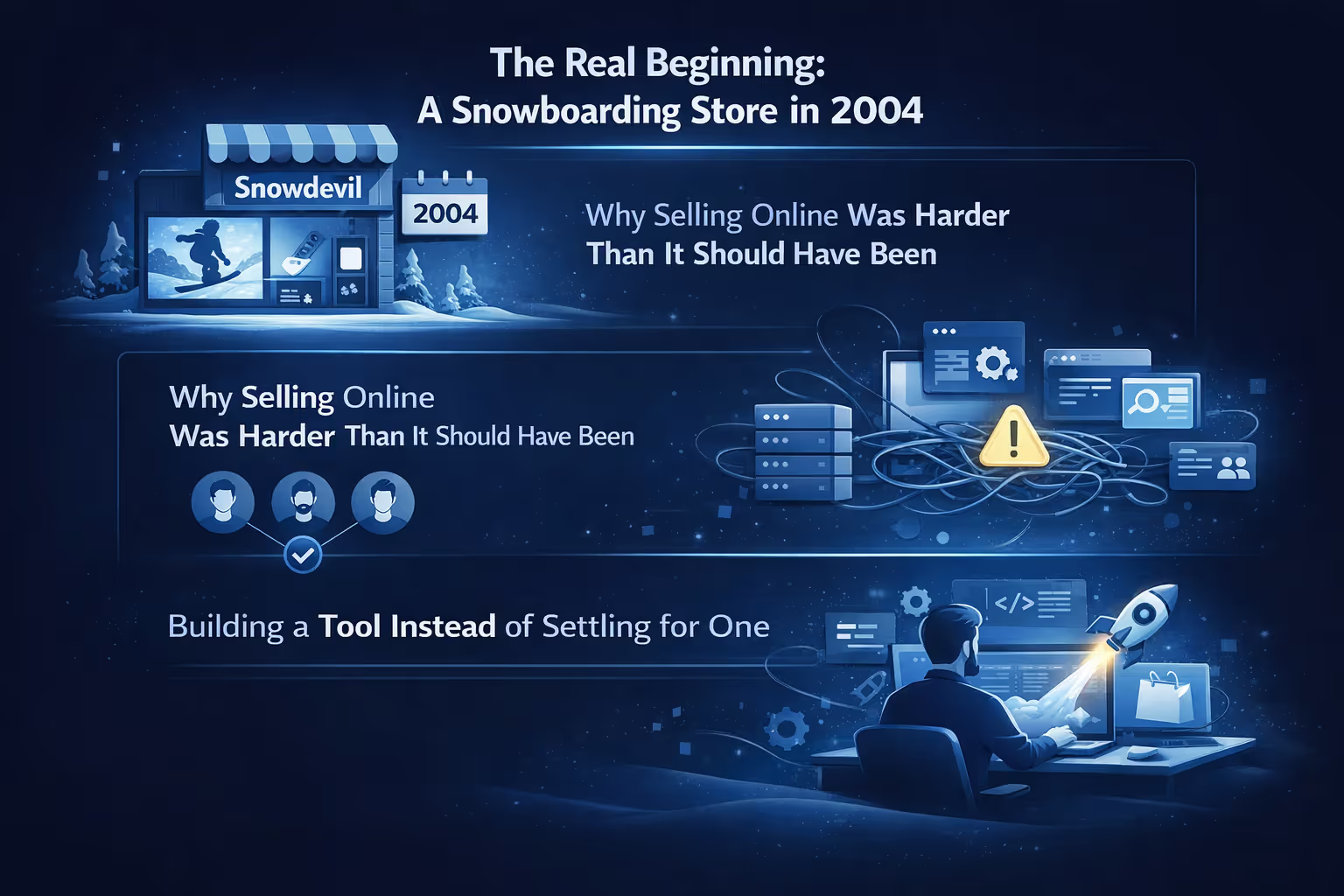
The Shopify story really begins in 2004, two years before the company officially launched. Tobias Lutke, Daniel Weinand, and Scott Lake were living in Canada and shared a passion for snowboarding. Like many early online entrepreneurs, they wanted to sell products directly to customers through an online store. They named their store Snowdevil, and at first glance, it seemed like a straightforward project.
It was not.
At the time, creating an online store required juggling multiple systems. You needed hosting, a content management setup, payment processing, order management, and customer data handling. None of these pieces worked well together. Even technically skilled founders had to spend more time fighting tools than selling products.
For non-technical merchants, the barrier was even higher.
Rather than settling for the available options, Tobias Lutke decided to build his own solution. He was a software engineer by background and approached the problem the same way he would any technical challenge. He started writing code to support Snowdevil, focusing on speed, simplicity, and control.
That internal tool worked. Snowdevil launched successfully, and the store ran on software that felt better than anything else available at the time.
After Snowdevil went live, something unexpected happened.
Other merchants noticed how the store was built and started asking questions. They wanted to know what software was being used and whether they could use it themselves. These were not casual compliments. They were repeated requests from people who were struggling with the same problems Snowdevil had already solved.
This was the turning point.
The founders realized they were spending more time improving their internal software than running a snowboarding business. More importantly, they saw a clear gap in the market. Content creators had WordPress and Blogger. Online sellers had nothing comparable.
Instead of trying to grow Snowdevil further, they made a deliberate decision to pivot. They would turn their internal solution into a product designed for other merchants.
That decision led directly to Shopify.
When the platform was first prepared for release, the company was called Jaded Pixel. It did not stay that way for long.
The name Shopify was chosen to reflect what the product was trying to do. Make it easier to set up and run an online shop. The emphasis was on approachability, not technical bravado.
In 2006, Shopify launched publicly.
From the start, it was different from existing e-commerce tools. It was hosted, which meant merchants did not need to manage servers. It combined store management, payments, and basic design into a single system. Most importantly, it was built by people who had used it themselves in a real business.
That origin shaped the product philosophy in ways that still matter.
Shopify did not become popular overnight. Its early growth was steady, driven by word of mouth and a growing base of merchants who appreciated how much friction it removed from selling online.
One of the most important early decisions was the creation of Liquid, Shopify’s open source templating language. Liquid allowed developers and designers to customize storefronts without breaking the underlying system.
This struck a balance that many platforms struggled to achieve. Beginners could launch quickly using themes. Advanced users could build deeply customized stores.
That flexibility helped Shopify attract a wide range of merchants, from solo founders to established brands experimenting with direct to consumer sales.
By 2009, Shopify was gaining traction, but the team faced a familiar problem. Merchants wanted more features than Shopify could reasonably build on its own.
Instead of trying to anticipate every possible need, Shopify borrowed an idea from another fast growing ecosystem. Apple’s App Store had shown how powerful third party development could be when paired with a strong core platform.
Shopify launched the Shopify App Store in 2009.
This decision transformed Shopify from a tool into a true platform. Developers could build apps for marketing, shipping, accounting, SEO, subscriptions, and automation. Merchants could install those apps with minimal effort.
The result was an ecosystem that scaled faster than any single company could manage alone. It also created a feedback loop. As more merchants joined Shopify, more developers built apps. As more apps became available, Shopify became more attractive to new merchants.
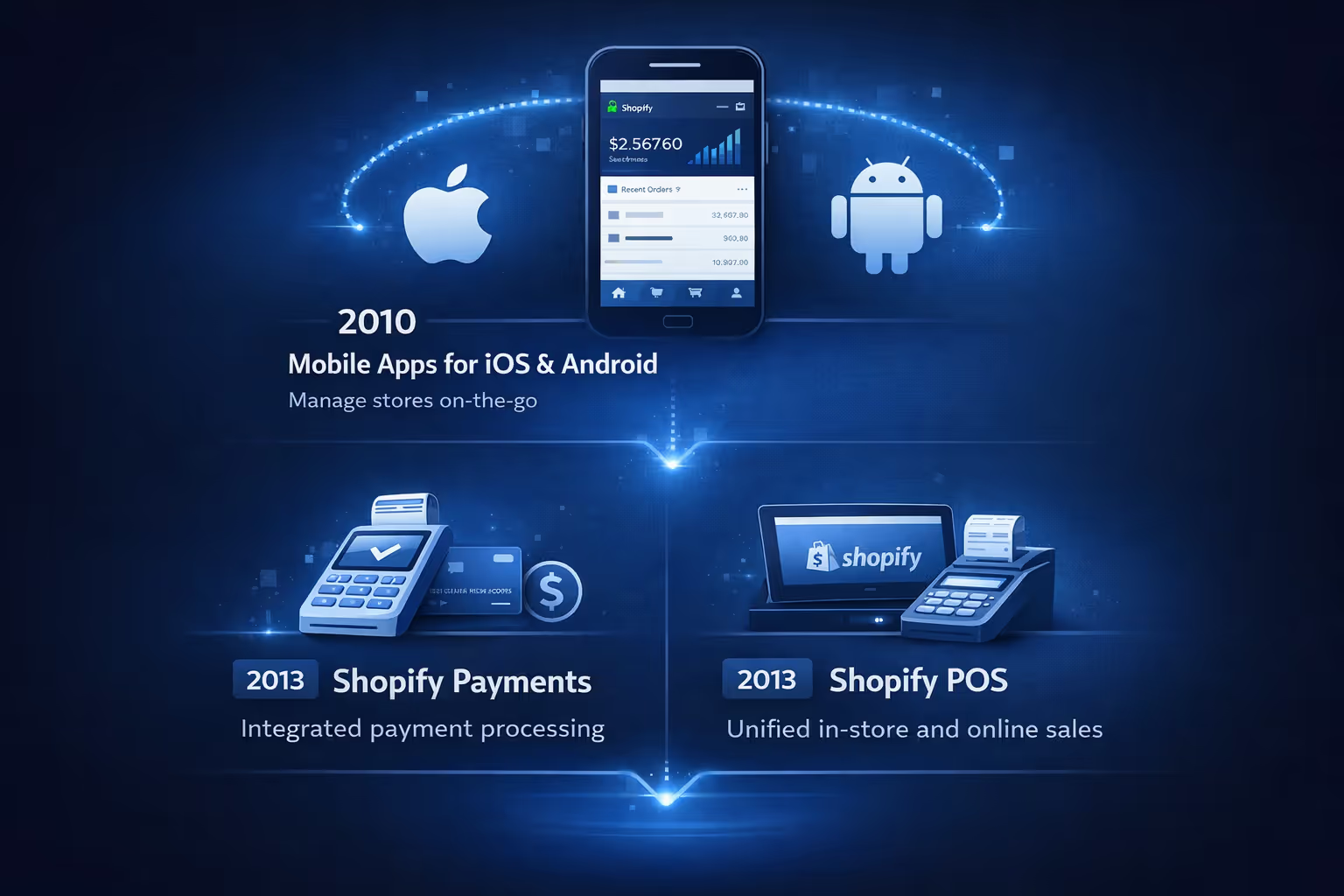
Shopify continued to evolve throughout the early 2010s. In 2010, it launched mobile apps for iOS and Android, allowing merchants to manage stores from their phones. This may seem obvious now, but at the time it positioned Shopify as a forward looking platform.
In 2013, Shopify made two major moves that expanded its role in commerce.
In 2013, Shopify introduced Shopify Payments, an in house payment processing system built in partnership with Stripe. This removed the need for third party gateways and simplified setup for merchants, especially those launching their first stores.
That same year, Shopify launched Shopify POS, allowing brick and mortar businesses to connect in store purchases with their online sales data. Inventory, orders, and customer information could now live in one system, helping Shopify serve retailers operating across both digital and physical channels.
Originally, Shopify was best known for serving small and mid sized businesses. Over time, larger brands began to take interest. They wanted Shopify’s reliability and ease of use, but needed more advanced features and support.
In response, Shopify launched Shopify Plus in 2014.
Shopify Plus was designed for high volume merchants with complex needs. It offered dedicated support, greater customization, and the ability to handle massive traffic spikes. Brands like Gymshark, Heinz, and Staples eventually adopted the platform.
This marked an important shift. Shopify was no longer just helping people start businesses. It was supporting global retail operations.
In 2017, Shopify introduced Shop Pay, originally known as Shopify Pay. It was positioned as a one click checkout designed to reduce friction for returning customers.
The impact was significant. Faster checkouts meant higher conversion rates. Shop Pay quickly became one of the strongest competitive advantages Shopify offered merchants.
That same year, Shopify announced deeper integrations with major marketplaces, reinforcing its role as a central hub rather than a closed system.
In 2019, Shopify launched the Shopify Fulfillment Network. Inspired in part by Amazon’s logistics model, the goal was to help merchants handle storage, shipping, and returns more efficiently.
While fulfillment has proven to be a challenging space, the move itself was telling. Shopify was thinking beyond software. It was positioning itself as a partner across the entire commerce lifecycle.
This infrastructure mindset continues to shape Shopify’s roadmap.

In 2021, Shopify introduced what became known as Shopify 2.0. This update focused on themes, performance, and flexibility. Developers gained more control over layouts, content, and app integration.
Around the same time, Shopify began investing heavily in headless and composable commerce. This allowed large businesses to decouple their front end experiences from Shopify’s backend systems.
For enterprises, this removed a key limitation. They could use Shopify’s commerce engine while building custom storefronts with modern frameworks.
Once again, Shopify leaned into flexibility rather than forcing a single way of working.
By the mid 2020s, artificial intelligence became a major focus for Shopify. The introduction of Sidekick, Shopify’s AI assistant, marked a shift in how merchants interact with the platform.
Sidekick helps with tasks like content generation, analytics interpretation, and operational recommendations. It does not replace decision making, but it reduces friction and speeds up common workflows.
Shopify has also introduced AI driven tools for store creation, personalization, and testing. These features reflect the same philosophy that shaped the platform from the beginning. Remove unnecessary work. Let merchants focus on their business.
Understanding when Shopify was founded is useful. Understanding why it was founded is more important.
Shopify exists because its founders experienced firsthand how broken e-commerce tooling was. They did not start by trying to disrupt an industry. They tried to sell snowboards and failed to find tools that worked.
That origin explains several things about Shopify today.
First, it prioritizes usability. Second, it values ecosystems over closed systems. Third, it grows by enabling others, not by controlling everything itself.
Those traits are not accidental. They were baked in from the start.

The early story of Shopify is about removing friction. The founders did not try to reinvent commerce for its own sake. They focused on making decisions easier, faster, and less expensive for merchants. That same principle is what guides Extuitive today.
At Extuitive, we work with Shopify merchants at a different stage of the journey, but the problem is familiar. Once a store is live, the next challenge is knowing which ads, messages, and creative ideas are actually worth scaling. Guesswork is expensive. Traditional consumer research is slow and often out of reach for growing brands. Our platform uses AI agents modeled after more than 150,000 real consumer profiles to help merchants generate, test, and validate ad concepts before spending real ad budget.
For Shopify sellers, that means clearer positioning and faster launches. We connect directly to a store, generate ad creatives and messaging, and validate them against simulated consumer responses to predict purchase intent. Instead of learning through trial and error in live campaigns, merchants can see what resonates first and launch with confidence. It is not about replacing ad platforms or creativity. It is about reducing uncertainty at the decision stage, so growth feels intentional rather than reactive.
To answer the question directly:
That distinction matters. Shopify is not a platform built in isolation. It is a product shaped by lived experience, technical skill, and a willingness to rethink how commerce should work.
Shopify’s rise was not instant, and it was not guaranteed. It was the result of steady decisions, careful expansion, and a consistent focus on reducing friction for merchants.
From a snowboarding store to a global commerce platform, Shopify’s founding story is less about a single launch date and more about a mindset. Build what you wish existed. Share it when others need it. Improve it as the world changes.
That mindset, more than any specific feature, explains why Shopify is still growing nearly two decades after it was founded.


