


Predict winning ads with AI. Validate. Launch. Automatically.
Facebook Ads Creative Testing Strategy 2026 Guide
Facebook Ads creative testing in 2026 prioritizes creative diversity over traditional targeting, with Meta's algorithm using engagement signals to find ideal audiences. Successful strategies combine broad audiences with systematic testing of 50+ creative variations monthly across multiple formats. The shift from interest-based targeting to creative-first approaches delivers better ROAS when paired with rigorous testing frameworks.
The Facebook Ads landscape shifted dramatically heading into 2026. Traditional interest-based targeting lost its edge, and performance marketers watched their Cost Per Lead climb while warm audiences stopped converting.
Here's what changed: Meta's algorithm now treats creative content as the primary targeting mechanism. The platform analyzes engagement signals—clicks, comments, watch time, shares—to automatically identify and reach ideal customer segments. This fundamental shift makes creative testing the most critical factor in campaign performance.
According to eMarketer data, 70% of Gen Z consumers say user-generated content (UGC) from everyday users is very helpful to their buying journey. More telling? 60% of all consumers consider UGC the most genuine form of advertising. That's not just preference data—it's a roadmap for what Meta's algorithm prioritizes in 2026.
Why Creative Became the New Targeting in 2026
Meta's algorithm evolution fundamentally changed how campaigns find audiences. Instead of marketers manually selecting interest categories and demographics, the system now reads creative signals to determine who sees ads.
This isn't theoretical. Community discussions among performance marketers reveal a consistent pattern: campaigns with broad audiences and diverse creative portfolios outperform tightly-targeted campaigns using limited creative variations.
The algorithm watches how different audience segments interact with specific creative elements. A comparison-style video might resonate with price-conscious shoppers. A testimonial-based ad attracts trust-seekers. Story-driven content engages emotional decision-makers.
But here's the thing—the algorithm can't optimize what it doesn't see. Running the same five ads for months gives Meta nothing to work with. The system needs variety to map engagement patterns across audience clusters.
Meta's early release program for AI creative tools signals where the platform is headed. According to eMarketer (May 2025), Meta is launching an 'early release' program to provide a small group of advertisers early access to AI creative tools. Translation? The platform recognizes that creative volume and diversity determine campaign success.
The Core Framework: Five Creative Styles That Drive Performance
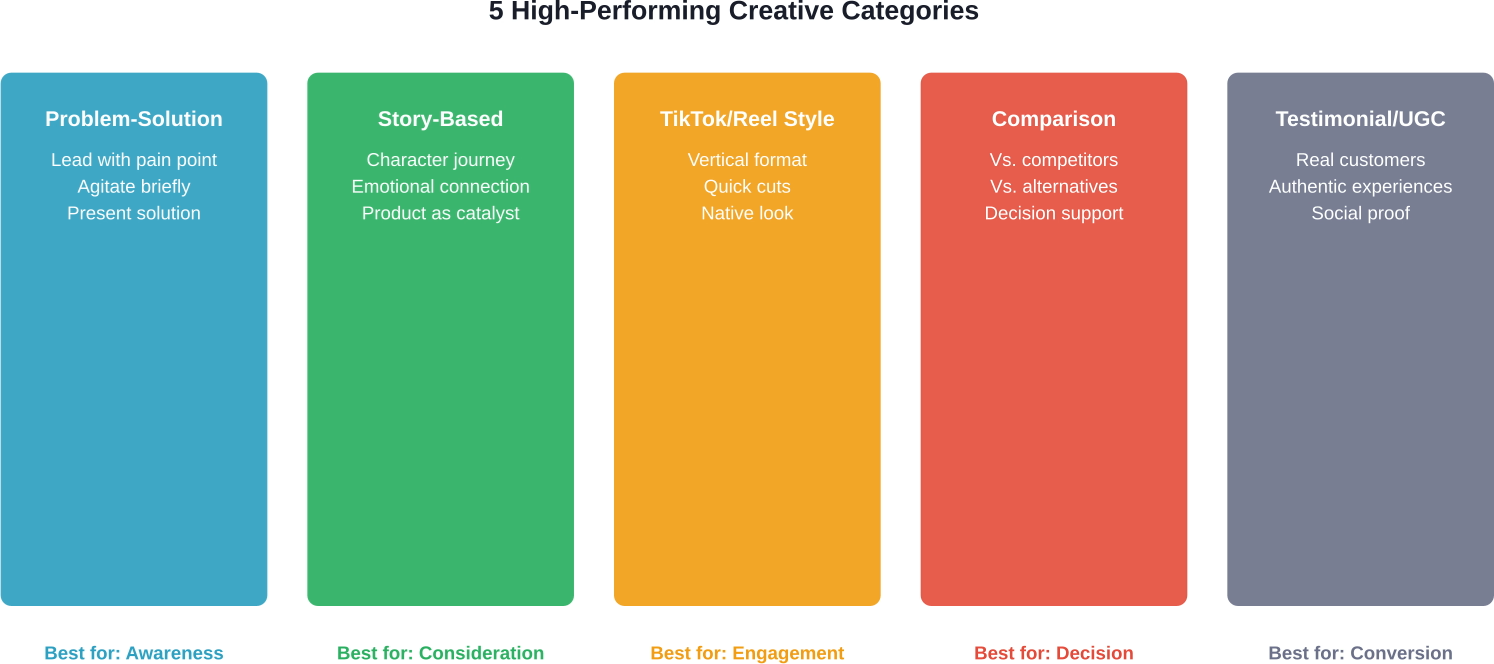
Testing without structure burns budget. The most effective creative strategy for scaling Facebook Ads in 2026 relies on five high-performing creative categories:
- Problem-Solution creatives lead with pain points. These ads identify a specific frustration, agitate it briefly, then present the product as the resolution. The format works because it triggers immediate recognition among people actively experiencing that problem.
- Story-based content uses narrative structure. These creatives follow a character's journey from struggle to success, with the product as the catalyst. They perform well for considered purchases where emotional connection matters more than immediate conversion.
- TikTok-style or Reel-format ads match native platform behavior. According to eMarketer, Meta debuted new ad options focused on Reels and Threads, reflecting where user attention concentrates. Short-form vertical video with quick cuts and text overlays blends seamlessly into feeds.
- Comparison creatives position products against alternatives. Whether comparing to competitors or to life without the solution, these ads help decision-ready buyers justify their choice. They work particularly well for audiences familiar with the category.
- Testimonial and UGC content leverage social proof. Real customers sharing genuine experiences carry credibility that polished brand content can't match. This aligns with research indicating paid social ads are effective when they borrow the credibility of organic content.
Predict Facebook Ad Creative Performance Before Launch

A creative testing strategy depends on what goes into the test. Extuitive predicts ad performance before launch using AI models validated against live campaign results. That gives teams a way to review Facebook ad creatives before spending budget on them in 2026 testing workflows.
Need to Check Creative Before Running Tests?
Use Extuitive to:
- predict ad performance before launch
- compare creatives before spending budget
- review ads before they go live
👉 Book a demo with Extuitive to see how it predicts ad performance before launch.
Building a Testing Campaign Structure That Scales
Campaign structure determines how quickly insights emerge. The most effective creative testing strategy for scaling Facebook Ads uses a two-tier system.
The testing campaign runs with broad audience parameters. One campaign, one ad set, multiple creatives. This consolidates budget and accelerates learning. The algorithm needs volume to identify patterns, and splitting budget across multiple ad sets delays that process.
Run new creative variations for three to four days. That timeframe provides enough data to assess click-through rate and engagement without committing excessive budget to underperformers. Research from Kellogg School of Management demonstrates that optimized testing approaches can reduce the number of observations needed by up to 50 percent while maintaining confidence in results.
Winners move to the scaling campaign. This second campaign gets proven creatives with demonstrated performance. The separation prevents testing turbulence from destabilizing profitable ad delivery.
But here's where most strategies fail: they stop testing once they find winners. Creative fatigue hits every ad eventually. The campaigns that scale sustainably test 50-plus creative variations monthly. That volume ensures fresh creative enters the scaling campaign before existing ads exhaust their audiences.
The Weekly Testing Rhythm
Consistency beats intensity in creative testing. A predictable weekly rhythm produces better results than sporadic creative dumps.
Launch 12-15 new creative variations weekly. That pace supplies enough volume for meaningful testing without overwhelming analysis capacity. Distribute new creatives across the five categories—two to three variations per creative style.
Monday launches give creatives the full work week to accumulate engagement data. Weekend behavior differs from weekday patterns, so starting tests mid-week skews initial results.
Review performance every Thursday. Three full days of data reveals which creatives warrant scaling. Move winners to the scaling campaign by Friday, giving them weekend exposure when social media usage peaks.
Kill underperformers immediately. No creative deserves endless chances. If an ad shows weak CTR or high cost-per-result after three days, it's not suddenly going to become a winner. Pause it and reallocate that budget.
Metrics That Actually Matter in 2026
Vanity metrics distract from performance indicators. The Meta Ads dashboard surfaces dozens of data points, but only a handful determine creative success.
CTR indicates whether the creative stops the scroll. Anything below 1.5% during testing signals weak hooks or poor audience-creative fit. Scaling candidates should clear 2.0%.
Engagement rate shows deeper resonance. Comments, shares, and reactions tell Meta the content delivers value. The algorithm prioritizes ads that generate genuine interaction because user behavior signals quality.
Don't obsess over conversion metrics during initial testing. Three days isn't enough time for proper conversion data, especially for products with longer consideration cycles. Use engagement and CTR to identify scaling candidates, then judge them on conversion performance once they enter the scaling campaign.
Combating Creative Fatigue Before It Kills Performance
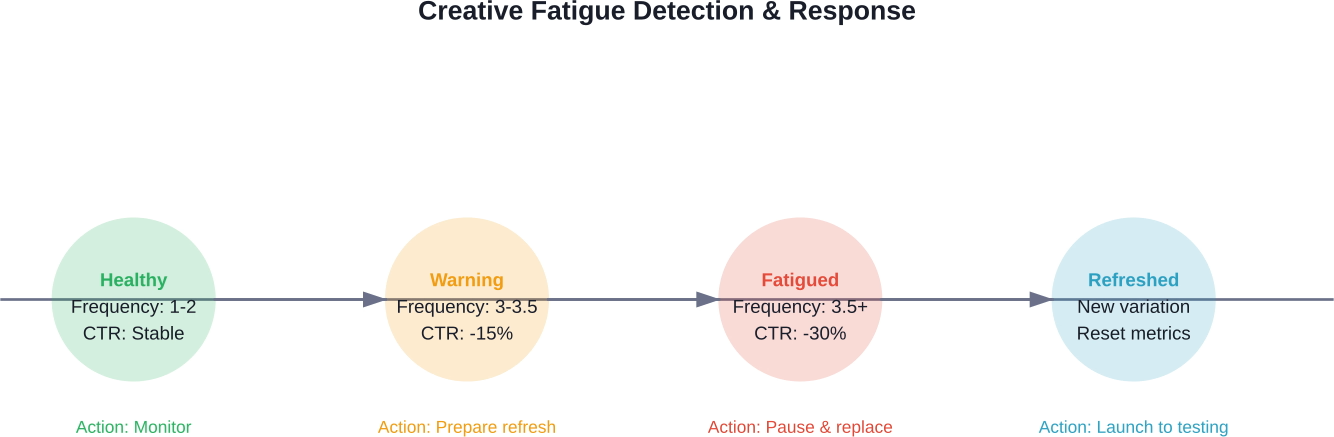
Creative fatigue isn't a failure—it's inevitable. Every ad eventually exhausts its responsive audience. The question isn't whether fatigue will occur, but how quickly the strategy detects and addresses it.
Frequency is the early warning system. When the same people see an ad repeatedly, performance degrades. Monitor frequency at the ad level. Once an ad hits 3.5+ frequency, performance typically deteriorates.
Cost increases signal fatigue. When a previously profitable ad's CPL or CPP climbs 25% above its baseline, that creative has exhausted its audience. Don't wait for complete failure. Rotate in a fresh variation before performance craters completely.
The refresh strategy matters as much as the initial creative. Take winning ad concepts and produce variations. Change the hook while keeping the core message. Swap the testimonial but maintain the format. Adjust the visual treatment while preserving the structure.
This approach maintains creative freshness without constantly rebuilding campaigns from scratch. Audiences get varied content while the overall strategy and messaging remain consistent.
Format Mixing: Reels, Stories, Carousels and Feed Placements
Placement diversity expands reach and prevents over-saturation. Different users have different consumption preferences. Some scroll Feed religiously but ignore Stories. Others live in Reels but rarely check their main Feed.
According to eMarketer, Meta debuted new ad options focused on Reels and Threads, reflecting where Meta sees growth and engagement heading.
Reels demand vertical video with quick hooks. The first second determines whether users swipe away. Use bold text overlays, pattern interrupts, or immediate visual interest. Audio matters more in Reels than in Feed—trending sounds boost distribution.
Stories work for sequential storytelling. The temporary, ephemeral nature makes Stories ideal for time-sensitive offers or behind-the-scenes content. Interactive elements like polls add engagement without requiring users to leave the story.
Carousel ads excel for product variety or step-by-step explanations. Each card needs to stand alone visually—users often don't swipe through entire carousels. Lead with the strongest image or message.
Feed placements still drive conversions for many businesses. The format allows longer captions and more detailed messaging. Feed ads work particularly well for complex products that need explanation.
Don't just produce one creative and deploy it across all placements. Adapt concepts to placement-specific requirements. A Reel winner might bomb in Feed. A carousel that converts in Feed might feel wrong in Stories.
The Monthly Testing Volume Benchmark
Performance marketers debate optimal testing volume constantly. Community discussions reveal a clear pattern: campaigns testing fewer than 30 creatives monthly struggle to scale.
The benchmark that separates scaling campaigns from stagnant ones? Fifty-plus creative variations monthly. That might sound excessive, but the math supports it.
Launch 12-15 creatives weekly. Over four weeks, that's 48-60 new variations. Not all will be completely original concepts—many should be iterations on proven frameworks. But the volume gives Meta's algorithm abundant data for audience mapping.
According to academic research from MIT Press, online controlled experimentation at scale proves to be a significant driver of business innovation. The research notes that experimentation provides a simple on-off switch and measurement capabilities that allow quick reversions when something goes wrong. At LinkedIn, 29% of changes were deemed too risky and abandoned before they reached even 50% traffic (Xu et al., 2018).
The key insight? Volume reduces risk. When testing 50 creatives monthly, a few failures don't tank overall performance. When testing five creatives monthly, each failure significantly impacts results.
AI Creative Tools and Automation in 2026
Meta's AI creative tools entered broader availability through early access programs. According to eMarketer (May 2025), Meta is launching an 'early release' program to provide a small group of advertisers early access to AI creative tools.
The AI tools work best for iteration, not origination. They excel at producing variations on proven concepts—changing backgrounds, adjusting copy, resizing for different placements. They struggle with truly novel creative concepts that require strategic thinking.
Smart strategies use AI for scale, not strategy. Human strategists identify winning frameworks and angles. AI tools then generate volume variations for testing. This hybrid approach combines strategic creativity with operational efficiency.
The automation capabilities extend to testing logistics. Advantage+ campaigns let Meta's algorithm handle placement optimization, audience expansion, and budget allocation. This works when the creative quality and diversity provide a solid foundation. Automation can't fix weak creative—it can only optimize distribution of strong creative.
Common Creative Testing Mistakes That Waste Budget
The most expensive mistake? Testing too few variations for too long. Campaigns that run three or four creatives for weeks generate minimal learning. The algorithm needs diversity to optimize.
Another critical error: changing multiple variables simultaneously. When testing a new video, don't also test a new headline, new targeting, and new placement. Isolate variables. That's the only way to identify what actually drives performance differences.
Premature scaling kills campaigns. Marketers see one strong day from a new creative and immediately dump budget into it. Give creatives time to stabilize. One great day might be statistical noise. Three consistent days indicate genuine performance.
Ignoring negative signals wastes budget. When an ad's engagement rate tanks or cost-per-result spikes, that creative is done. Don't throw good money after bad hoping performance recovers. It rarely does.
The final major mistake: no systematic documentation. Without tracking which creative concepts work and why, every test starts from zero. Build a creative library that categorizes concepts, performance data, and key learnings. This institutional knowledge becomes more valuable than any individual ad.
Taking Action: Building a Sustainable Testing System
Creative testing strategy isn't a one-time project—it's an operational system. The campaigns that scale profitably in 2026 treat creative production and testing as core business functions, not occasional marketing tasks.
Start by auditing current creative volume. How many unique ad variations launched last month? If the number is below 30, creative volume is the constraint limiting scale. Increasing testing frequency matters more than perfecting individual ads.
Establish a production pipeline that delivers 12-15 new creatives weekly. This might require hiring content creators, building relationships with UGC providers, or developing internal production capacity. The investment pays returns through reduced creative fatigue and improved cost efficiency.
Implement the two-campaign structure immediately. Separate testing from scaling to accelerate learning and protect profitable ad delivery. This structure change alone often improves overall account performance by 20-30%.
The Facebook Ads landscape will continue evolving. Algorithm updates will arrive. New placements will launch. Creative formats will shift. But the fundamental principle remains constant: diverse, systematically-tested creative drives performance in Meta's AI-powered advertising ecosystem.
Campaigns that commit to high-volume creative testing position themselves to capitalize on algorithm improvements rather than suffer from them. When Meta releases new AI creative tools or placement options, accounts with strong testing infrastructure adapt quickly. Those still running last year's static ads struggle.
The choice is clear. Build a creative testing machine that feeds Meta's algorithm the diversity it needs to optimize, or watch costs climb while competitors scale.
Frequently Asked Questions
Predict winning ads with AI. Validate. Launch. Automatically.


