Top Shopify B2B Agencies You Should Know
Top Shopify B2B ecommerce agencies that help you streamline operations, boost sales, and build a frictionless buyer experience from day one.
Mar 24, 2026



Shopify feels like one of those companies that has always been around. It powers millions of stores, shows up in earnings headlines, and quietly sits underneath a huge share of online commerce. Still, one simple question keeps coming up: who actually owns Shopify?
The short answer is not as straightforward as it sounds. Shopify is a public company, which means ownership is spread across investors all over the world. At the same time, real control sits in far fewer hands. To understand how Shopify works as a business and why it makes the decisions it does, it helps to look past the stock ticker and into how ownership is structured today.
Shopify is a publicly traded company. Its shares trade on both the New York Stock Exchange and the Toronto Stock Exchange under the ticker symbol SHOP. This means anyone can technically own a piece of Shopify by buying its stock.
Public ownership often creates the impression that control is widely distributed. In practice, that is rarely true, and Shopify is no exception.
When a company goes public, it does not automatically give up strategic control. What it does is open ownership to the market. Control depends on how voting rights are structured, not just how many shares exist.
Shopify went public in 2015, but it did so in a way that protected long-term leadership rather than handing decision-making power to the market.

Before ownership, shareholders, or long-term control matter, most Shopify businesses face a simpler question. What actually works?
At Extuitive, we help Shopify founders validate products, ads, and pricing before they scale. Our AI growth agent uses a proprietary network of over 150,000 AI consumer agents trained on real behavioral data. They act as an always-on focus group, testing concepts, creatives, visuals, and pricing to surface what resonates.
Creation inside Extuitive is evolutionary, not linear. We generate multiple variants, apply performance-based pressure, and identify the strongest ideas fast. For Shopify brands, that means less guesswork, faster launches, and smarter ad spend. While Shopify is built for long-term stability, Extuitive helps you reach that stage with confidence.
Shopify was founded in 2006 by Tobias Lütke, Daniel Weinand, and Scott Lake. The origin story is well known by now. Lütke wanted to sell snowboards online and could not find software that met his expectations, so he built his own.
From the beginning, Shopify was shaped by a product-first mindset. That matters when thinking about ownership, because it explains why technical leadership stayed central even as the company grew.
Scott Lake exited early. Daniel Weinand later stepped away from daily operations. Tobias Lütke stayed. Over time, his role shifted from founder to CEO to long-term steward of the company.
That continuity is rare among large technology companies, especially those operating at Shopify’s scale.
Tobias Lütke is still Shopify’s CEO and remains the most important individual in the company’s ownership and governance structure.
While Shopify is public, Lütke holds a special class of shares that give him outsized voting power. These shares allow him to control a majority of voting rights without owning a majority of economic shares.
This distinction is critical.
From a financial perspective, Lütke owns a fraction of Shopify compared to institutional investors. From a governance perspective, he has effective control.
This structure ensures that Shopify’s strategic direction cannot be easily overridden by activist investors or short-term market pressures. Major decisions still run through leadership rather than shareholder votes driven by quarterly performance.
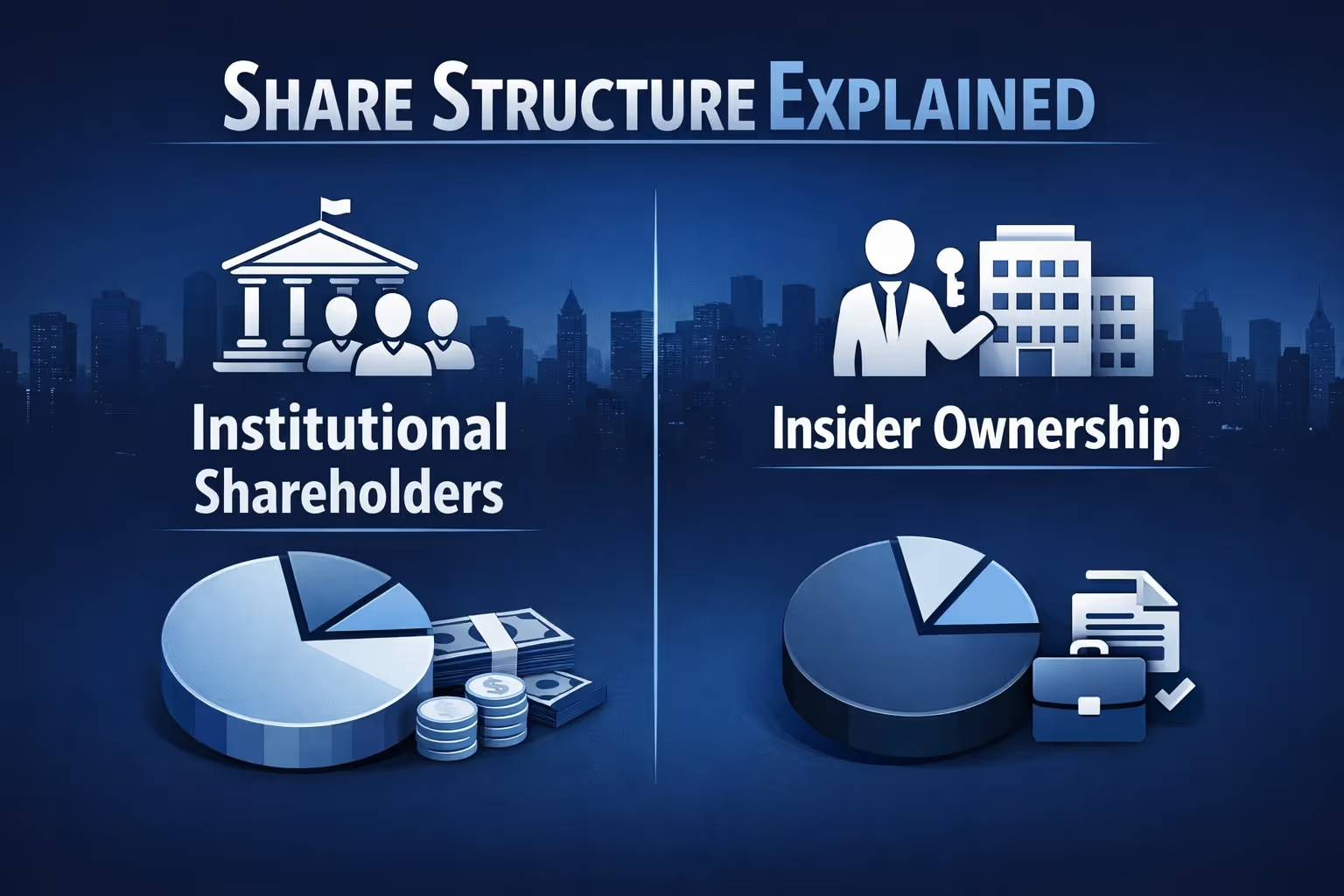
Shopify utilizes a governance structure centered around a Founder Share, which provides Tobias Lütke with 40% of the total voting power, alongside a dual-class system for other shareholders. This setup is common among founder-led tech companies and is designed to protect long-term decision-making.
Even though Shopify is publicly traded, control remains centralized. Tobias Lütke and the board retain authority over strategy, leadership, and major company decisions. At the same time, Shopify remains fully accountable through public reporting, regulatory oversight, and earnings disclosures.
Institutional investors such as Vanguard, BlackRock, and Fidelity own large blocks of Shopify stock, mainly through funds and ETFs. Their activity influences share price and market stability, but not company operations.
Most of these investors are passive, focused on portfolio allocation rather than governance. Even active funds rarely have enough voting power to influence Shopify’s direction in any meaningful way.
Shopify executives and long-term employees also hold shares, largely through equity compensation. This helps align leadership incentives with company performance but does not change who controls the business.
Insider sales tend to be routine and planned, often tied to diversification or compensation schedules. Limited insider buying at current prices reflects valuation caution, not a lack of confidence in Shopify’s future.
Even with founder control, Shopify does not operate in a vacuum. Public markets still impose real constraints that shape how the company runs day to day.
Shopify must consistently account for:
What founder control changes is not whether Shopify listens to these signals, but how it responds to them. Instead of optimizing around every earnings cycle, the company can commit to multi-year strategies. That flexibility matters more now than it did during Shopify’s hyper-growth phase, as the business shifts toward long-term efficiency and operational maturity.
From an investor’s standpoint, Shopify’s control structure is both a strength and a risk.
On one hand, it reduces the chance of destructive activism or forced strategy changes. On the other, it limits shareholders’ ability to influence leadership decisions.
Market reactions reflect this trade-off. Shopify’s stock attracts long-term investors comfortable with founder leadership. It repels those seeking quick structural changes.
Recent institutional activity shows mixed sentiment, not panic. Some funds trim exposure. Others add. That balance suggests confidence in the platform, with debate over valuation rather than governance.
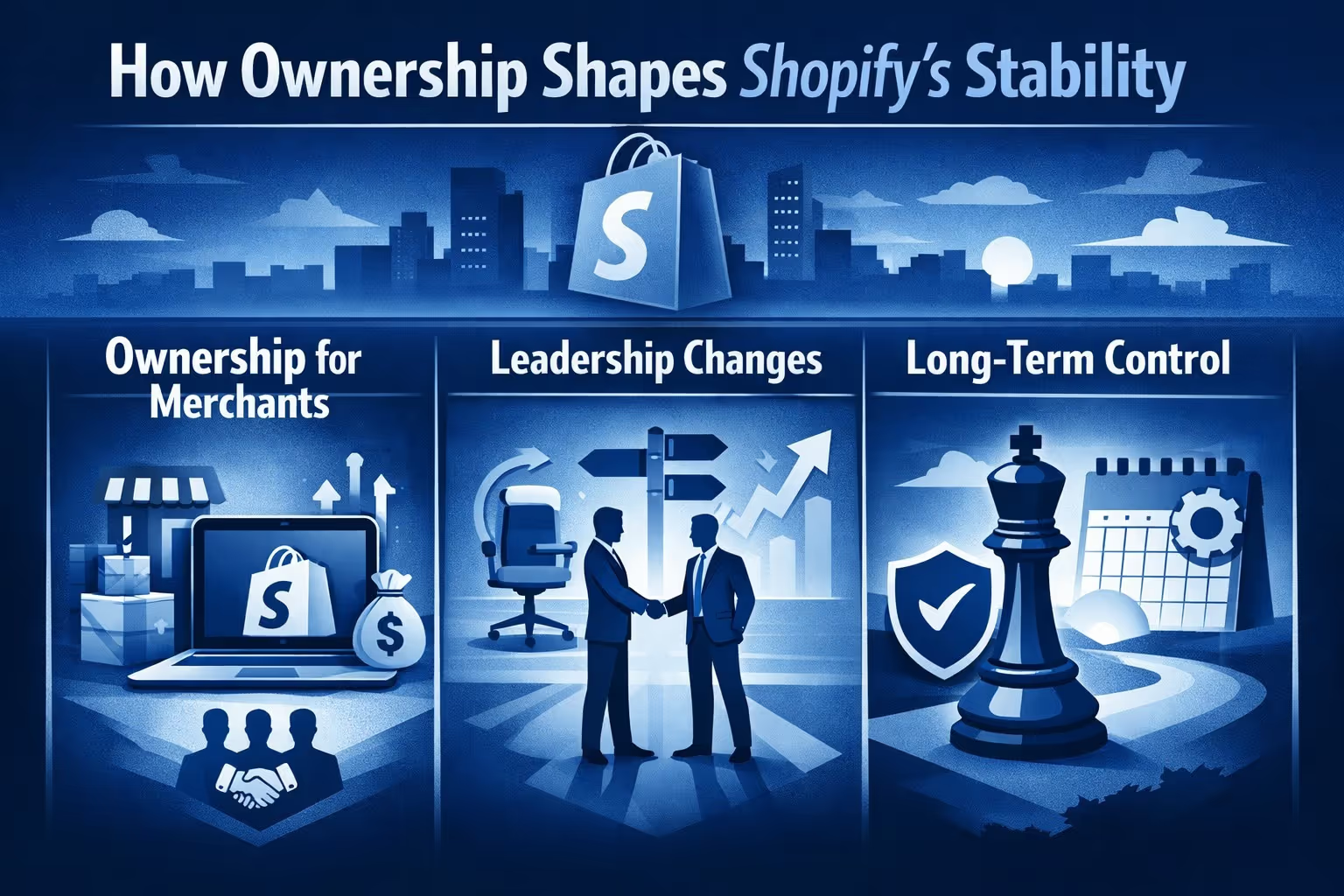
Ownership affects how Shopify behaves as a platform. Founder-led control has supported pricing transparency, open APIs, and a competitive app ecosystem rather than a locked-down marketplace. Themes, integrations, and developer tools continue to evolve without sudden shifts driven by outside pressure.
Shopify has also avoided becoming a closed advertising or data-extraction platform. That choice reflects long-term thinking rather than short-term monetization.
If Tobias Lütke steps aside in the future, Shopify’s governance structure would still provide continuity. The dual-class share system does not disappear automatically, and leadership transitions would be guided by the board, not market reactions.
Change would be planned, not abrupt. The company would continue to evolve without losing direction.
Shopify’s ownership structure supports long-term investment. Expansion into enterprise commerce, point-of-sale systems, headless architecture, and AI tools requires time and patience.
Founder control gives Shopify room to invest ahead of demand and absorb setbacks along the way. Success will still depend on execution, but the structure allows the company to operate on its own terms.
So who owns Shopify?
On paper, millions of shareholders across the globe. In reality, control rests with a small group led by Tobias Lütke, protected by a governance structure designed for long-term thinking.
That control has shaped Shopify into what it is today. A platform that prioritizes merchants, invests in infrastructure, and resists short-term trends when they conflict with core principles.
For users, investors, and observers alike, understanding this ownership model makes Shopify’s behavior easier to understand. It explains patience, consistency, and sometimes stubbornness.
Ownership is not just about shares. It is about direction. And in Shopify’s case, direction has remained remarkably steady.


