How to Close Your Shopify Store Without Missing a Step
Step-by-step guide to shutting down your Shopify store, plus what to do before you deactivate.
Jan 7, 2026



Shopify often gets described as an “all-in-one ecommerce platform,” but that phrase hides more than it explains. Some people think Shopify builds their business for them. Others assume it is just a website builder with a checkout attached. The truth sits somewhere in between.
At its core, Shopify provides the infrastructure that lets a business sell. It handles the technical foundation most people do not want to build or maintain themselves, while leaving key decisions, products, pricing, and growth entirely in the owner’s hands. To understand Shopify properly, it helps to look at what it actually takes responsibility for, and what it deliberately does not.
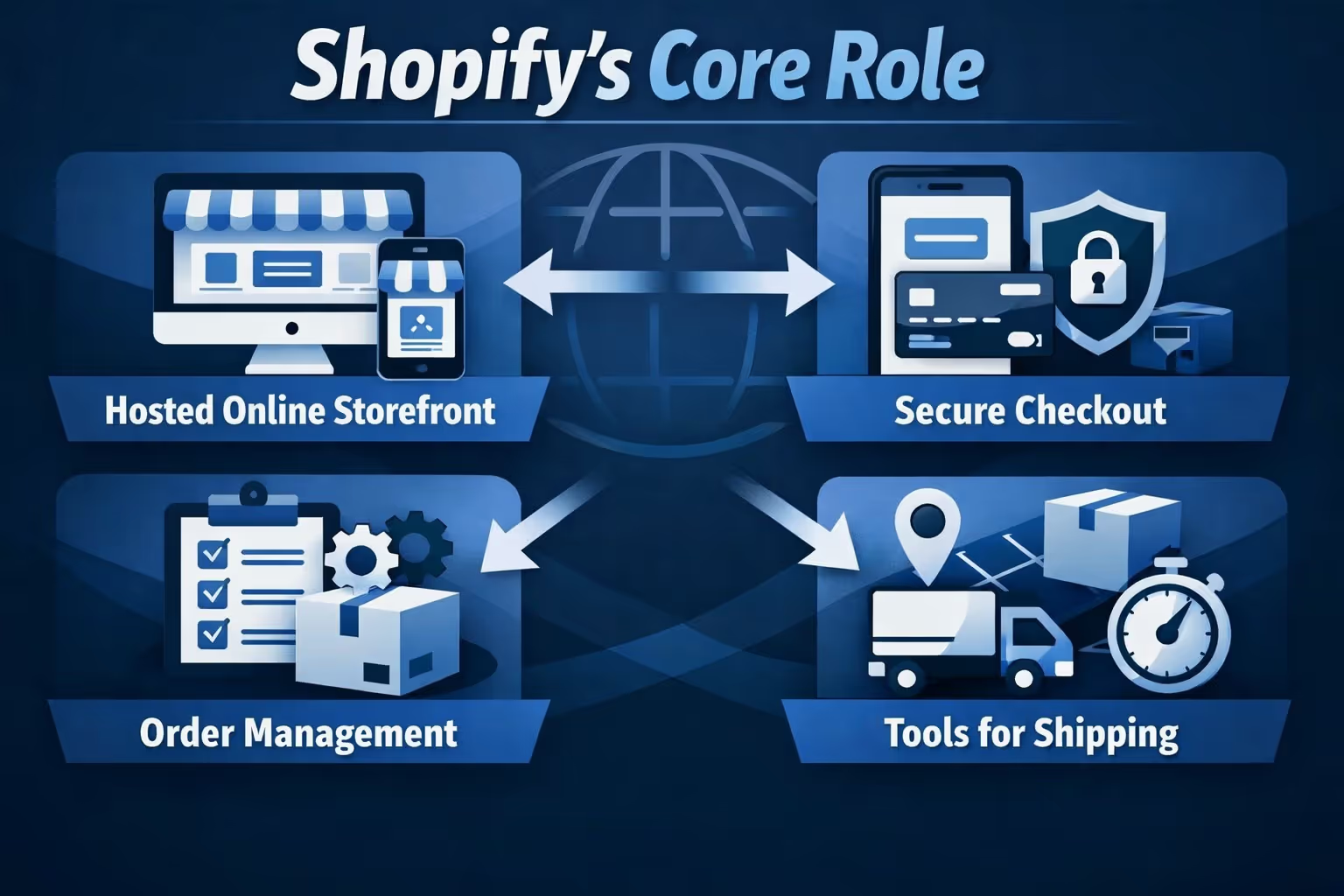
One of the biggest misunderstandings about Shopify is the idea that it runs your business for you. It does not. Shopify does not choose your products, find your customers, or decide your strategy.
What it does provide is the infrastructure that makes selling possible.
That includes:
Think of Shopify as the operating system for commerce. It creates a stable environment where selling can happen, but it leaves the actual business decisions to you. That division of responsibility is intentional, and it is part of why Shopify scales from small stores to enterprise setups without forcing a full rebuild.
At the most visible level, Shopify lets you build an online store.
This is not just about design. It is about removing the need to worry about servers, updates, security patches, or performance tuning. Shopify hosts the store, manages uptime, and keeps the system running behind the scenes.
For store owners, that means:
The store builder itself is intentionally restrained. You can customize layout, colors, typography, and structure, but the system is designed to prevent accidental breakage. For most businesses, that tradeoff is worth it. It keeps the store stable while still allowing enough flexibility to express a brand.
More advanced teams can go further using custom themes, headless setups, or external frontends. Shopify does not block that path, but it does not force it either.

Shopify gives businesses a strong foundation to sell, but many struggles happen before checkout. Ads miss the mark, messages do not resonate, and budgets get spent testing ideas that never convert. That is the gap we built Extuitive to close.
We work with Shopify brands to create, validate, and launch ads with more certainty. By connecting directly to a Shopify store, we generate ad creatives and copy tailored to the products and brand, then test them using AI agents modeled after more than 150,000 real consumer profiles. This lets teams see which messages are likely to drive purchases before spending real money.
For Shopify merchants, this means faster decisions and less guesswork. Instead of running endless experiments, they launch ads that have already been pressure-tested, reducing risk while speeding up growth.
Selling online quickly becomes messy without a reliable way to manage products. Prices change, variants multiply, and inventory spreads across channels faster than most teams expect. Shopify steps in as a central source of truth for product data.
Within Shopify, merchants manage product titles and descriptions, images and other media, variants such as size or color, pricing and discounts, and inventory levels across one or multiple locations. All of this lives in a single system that updates consistently as changes are made.
Once products exist in Shopify, they can be reused across sales channels. That matters more than it sounds. Your website, marketplaces, social platforms, and physical stores can all pull from the same product data instead of operating in separate systems. For growing businesses, this centralization reduces errors and saves time. For larger ones, it becomes essential.
Checkout is where ecommerce either works or quietly falls apart. Customers can forgive a slow homepage or an imperfect product page. They rarely forgive a confusing or unreliable checkout.
Shopify takes full ownership of this part of the experience, and that is one of its most important roles.
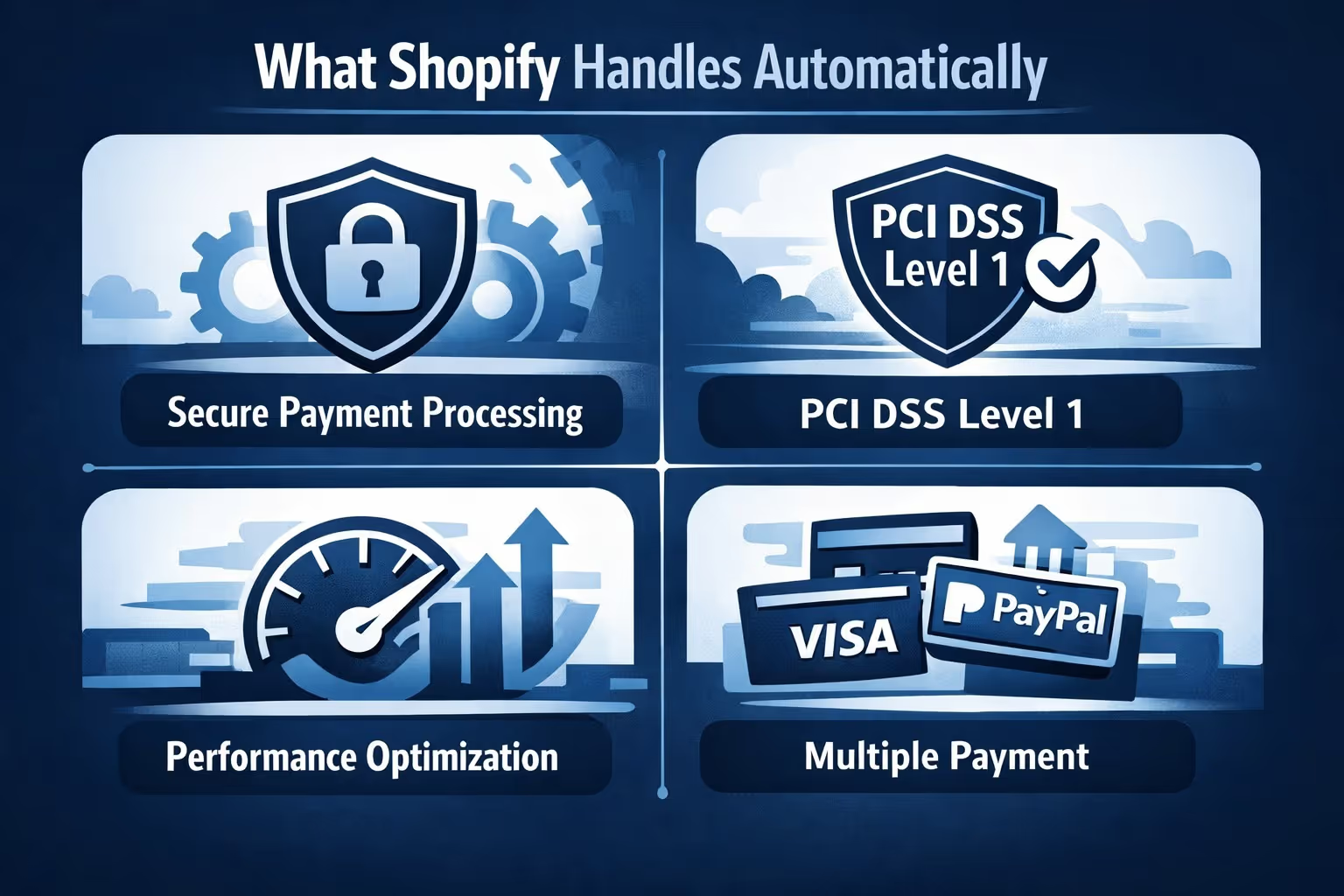
Shopify’s checkout is hosted, maintained, and optimized by Shopify itself. Merchants do not manage the underlying infrastructure, and that is deliberate.
Out of the box, Shopify handles:
This matters because checkout is not just a design problem. It is a technical and regulatory one. Building and maintaining a secure, compliant checkout system independently is expensive and risky, especially for small teams.
By centralizing checkout, Shopify spreads that complexity across millions of stores.
Even though Shopify controls the core mechanics, merchants are not locked out of decision making. They still have meaningful influence over how checkout works in practice. Store owners can decide which payment methods to offer, how shipping rates and taxes are calculated, and how discounts behave at checkout. They can also adjust the language customers see and apply branding elements within Shopify’s framework.
For larger businesses, Shopify Plus opens the door to deeper customization. But even on standard plans, the balance is intentional. Shopify protects the stability of checkout while giving merchants enough flexibility to meet customer expectations without putting performance or reliability at risk.
Many ecommerce tools compete on design, animations, or page builders. Shopify’s advantage is quieter.
A fast, predictable checkout reduces abandoned carts. A reliable payment flow reduces support tickets. A consistent experience builds trust, even if customers never consciously notice it.
That is the kind of advantage businesses feel in their numbers, not their screenshots.
Once a sale happens, the real work begins.
Shopify tracks orders from the moment checkout is completed through fulfillment and post-purchase handling. Merchants can view and manage incoming orders, update their status, generate shipping labels, share tracking information with customers, and handle refunds or returns from a single dashboard. This keeps order management predictable, even as volume grows.
Shipping is often where new sellers struggle. Rates, carriers, customs rules, and tracking can quickly become overwhelming. Shopify simplifies this process by integrating with major shipping carriers and offering discounted rates in many regions. Labels, tracking, and customer notifications are built into the same system that manages orders, which reduces manual work and mistakes.
As order volume increases, Shopify can also connect merchants to fulfillment partners or networks. This allows businesses to outsource storage, packing, and returns without leaving the Shopify ecosystem. Not every merchant uses these services, but having the option to grow into them matters. It lets businesses scale operations gradually instead of rebuilding their logistics setup all at once.
Shopify does not replace marketing expertise, but it does provide the tools needed to act on it. Instead of guessing what works, merchants can rely on concrete data pulled directly from their store activity. Shopify surfaces sales reports, performance dashboards, customer behavior data, and conversion tracking in a way that ties actions to outcomes.
This information helps answer practical questions that come up once a store is live. Which products actually sell consistently? Where do customers drop off in the buying process? Which channels bring repeat buyers instead of one-time traffic? Which promotions move revenue and which ones only create noise?
Shopify’s analytics are intentionally accessible. They are designed to be understood by business owners, operators, and small teams, not just analysts. Metrics are presented in context, with clear relationships between traffic, orders, and revenue. For many businesses, this level of visibility is enough to guide day-to-day decisions without needing a separate analytics stack.
For teams that need deeper insight, Shopify data can be exported or connected to external tools. The platform does not trap information inside its own dashboards. The goal is clarity, not complexity.

No platform can cover every use case out of the box, and Shopify does not pretend otherwise. Instead, it leans heavily on its app ecosystem to stay flexible without becoming unstable. The Shopify App Store includes tools that cover areas like email and SMS marketing, customer support, accounting and finance, inventory forecasting, subscriptions, custom shipping logic, and internationalization.
Apps allow merchants to add functionality without modifying the core platform. This modular approach keeps Shopify stable while still adaptable as business needs evolve.
For businesses with unique requirements, Shopify also supports custom apps and direct integrations. Through its APIs, developers can connect Shopify to ERP systems, CRMs, fulfillment services, and internal tools. This makes it possible to build more complex workflows without abandoning the platform or duplicating data across systems.
This flexibility is one of Shopify’s quieter strengths. It allows businesses to grow in complexity while keeping a single commerce foundation in place, instead of forcing a full rebuild every time operations evolve.
One reason Shopify appears across so many industries is that it is not tied to a single way of selling. The platform is flexible enough to support very different business models without forcing owners into rigid templates or workflows. The same core system adapts based on how it is used.
Common business models built on Shopify include:
What makes this possible is not a separate platform for each model, but a shared foundation. The underlying system stays the same while features are combined in different ways. Payments, inventory, customer data, and reporting all adapt to the business instead of dictating how it must operate.
This adaptability allows Shopify to meet businesses where they are today, and continue supporting them as their model evolves over time.
Understanding Shopify also means understanding its limits. Shopify does not generate demand automatically, guarantee profitability, replace product market fit, or remove the need for strategy and execution. Those responsibilities remain firmly with the business owner and the team behind the store.
Shopify is a powerful tool, but it does not eliminate the fundamentals of running a business. Stores fail on Shopify for the same reasons they fail elsewhere. Weak products, unclear positioning, poor marketing, or unrealistic expectations tend to surface regardless of the platform being used. Shopify works best when it supports a sound business, not when it is expected to fix one.
Many platforms can help someone launch. Fewer can support a business as it matures.
Businesses stay with Shopify because it:
There is also an intangible factor. Shopify tends to stay out of the way. It does not constantly demand attention or force redesigns. It allows businesses to focus on their customers instead of their infrastructure.
For many owners, that alone is worth the tradeoffs.
So what does Shopify do?
It provides the foundation that makes selling possible without demanding that every business become a technology company. It handles the hard, invisible parts of commerce and leaves the visible decisions to the people running the business.
That balance is why Shopify shows up everywhere from solo projects to global brands. It does not promise miracles. It offers stability, flexibility, and room to grow.
For businesses that want to spend less time managing systems and more time building something real, that promise matters.


