Marketing Ideas for Therapists That Actually Work in 2026
Discover proven marketing strategies for therapists to attract clients ethically. From SEO to referrals, learn what works in 2026 for private practices.
May 18, 2026



You’ve probably been there. An ad that crashed last month suddenly tanks. Cost per result spikes, conversions dip, and you’re left scratching your head. That’s where A/B testing comes in – not as a magic fix, but as a process that lets you stop guessing and start making smarter decisions.
Running Meta ads without testing is like throwing darts blindfolded. Sure, you might hit the board now and then, but you're not really in control. In this guide, we'll walk through the A/B testing best practices that help brands figure out what’s actually working, and just as importantly, what’s not. From setting up a clean experiment to knowing when to pull the plug, here’s how to test like a pro, not just push buttons and hope.
The best practices around A/B testing in Meta ads are shifting – not just to improve speed, but to regain control. Traditional testing loops are slow, costly, and increasingly unreliable in a platform that reveals less and changes often. At Extuitive, we replace this cycle with predictive advertising: a method that evaluates performance before launch, using data instead of guesswork.
Predictive advertising means moving decisions to the front of the process. We combine your historical campaign performance with large-scale simulation through over 150,000 AI agent consumers. Each creative is scored for predicted CTR and ROAS, ranked, and filtered before reaching the ad account.
This makes A/B testing optional. You no longer need to launch a weak variant to learn it underperforms – we at Extuitive already know. The result is fewer wasted impressions, faster go-to-market cycles, and a creative pipeline built on confidence, not trial.
Meta Ads A/B testing, also called split testing, is the practice of running two or more ad variations at the same time to see which one performs better. Each version is shown to a similar audience, with one controlled change between them. That change could be the headline, the creative, the call to action, or the audience itself.
The idea is simple. Instead of guessing why one ad works and another does not, you let real data decide. By comparing performance metrics like click-through rate, cost per result, or return on ad spend, you can clearly see which version drives better outcomes. When done correctly, A/B testing turns ad optimization from trial and error into a repeatable process you can rely on.
There’s no shortage of advice out there on how to run A/B tests, but most of it feels like guesswork dressed up in technical terms. What you need are the practices that consistently lead to clearer decisions, stronger performance, and fewer wasted ad dollars.
Below are the most useful and proven approaches to testing Meta ads – things that real teams apply when they want real answers. If you're looking to get better results without burning through your budget, start here.
If you’re testing two ads that have different images, different headlines, different audiences, and different CTAs... you’re not testing. You’re throwing spaghetti at the wall.
For any A/B test to be useful, you need to change one variable at a time.
Here’s what that might look like:
If you tweak too many things at once, you won’t know which change caused the improvement (or the drop). Start small, stay focused.

A lot of wasted ad spend comes from not knowing what you’re actually trying to learn. Before you even launch your test, answer this: “What metric are you using to judge success?”, “How much improvement would make the new version a “winner”?”, and “How long will you run the test?”
Common metrics:
You don’t need to monitor every single one. Pick the metric that matches your goal. For sales campaigns, CPA and ROAS usually matter most. For brand awareness, CTR might be your focus.
One of the biggest traps in A/B testing is underfunding your test and then trying to draw conclusions from weak data. If you’re running a campaign where the average CPA is $25, and you give each version a $30 budget... you’re not going to get anywhere.
A good rule of thumb is to aim for at least 50 conversions per variation. For statistically meaningful results, 100 is even better.
Let’s say your expected cost per acquisition is around $20, and you're aiming for 50 conversions per variation to get solid data. That means you’ll need about $1,000 for each version of the ad, or $2,000 total to run the test properly. It’s not a small spend, but anything less might leave you with numbers that don’t actually tell you much.
Not every test needs that much money, especially if you're optimizing for clicks instead of purchases. But the point is: don’t cheap out and expect solid answers.
Yes, watching performance in real time is tempting. And yes, it’s hard not to panic when one version looks like it’s losing. But ending a test after 48 hours because one ad is slightly ahead? That’s a mistake.
Why? Because performance can vary over time depending on delivery dynamics and user behavior. Results may fluctuate by day or time of week, with differences often appearing between weekdays and weekends rather than reflecting a true winner early on.
Give your tests time. In most cases, run them for at least 7 days, don’t check results obsessively in the first 48 hours, and wait until you hit enough data to make a statistically sound call. Consider, these are not general rules. Most likely, practical advice.
Meta’s built-in split testing feature exists for a reason. It helps isolate individual variables and distributes audience segments in a randomized way to prevent overlap, ensuring that the same user does not see both versions.
Manual testing is fine if you know what you’re doing, but it’s easier to mess up. When you run two ad sets with similar targeting, overlap can happen. You end up bidding against yourself, and your results get murky.
For audience tests in particular, the split test tool is safer. It prevents the “self-sabotage” effect and makes sure results are clear.
There’s a difference between curiosity tests and needle-movers. Not everything you test will lead to big changes. That’s fine. But if you want impact, prioritize high-influence elements.
Good places to start:
Testing background colors or punctuation might be fun, but unless your ads are already highly optimized, focus on the big stuff first.

Most marketers run a test, pick a winner, scale it, and forget it. That’s a wasted opportunity.
Keep a record of what you tested, what changed, what the results were, and how statistically strong the outcome was. Over time, you’ll build a knowledge base that helps future campaigns go faster and perform better.
Create a testing log that includes:
It doesn’t have to be a formal spreadsheet. Even a shared doc with bullet points can work. The goal is to learn and not repeat the same failed tests over and over.
Running the same creative all year isn’t just boring - it can underperform badly during seasonal cycles. A/B testing is your friend when adapting messaging to different times of year, holidays, or cultural moments.
Test variations like “Back to School” vs evergreen headlines in August, “Holiday Gift Guide” vs “Everyday Favorites” in December, and “Beat the Heat” vs “Stay Active Year-Round” in summer.
Don’t assume what worked last season will still work today. People's mindsets shift, and testing allows you to stay fresh without guessing.
Sometimes your test gets skewed by stuff outside your control. A competitor launches a sale. A major news event changes behavior. Or Meta’s algorithm just decides to behave differently one week.
This doesn’t mean you scrap every test that runs during a weird week. It just means you need to add context.
If results look strange or too good to be true:
A good rule: if something feels “off,” wait. Extend the test. Look wider before making a call.
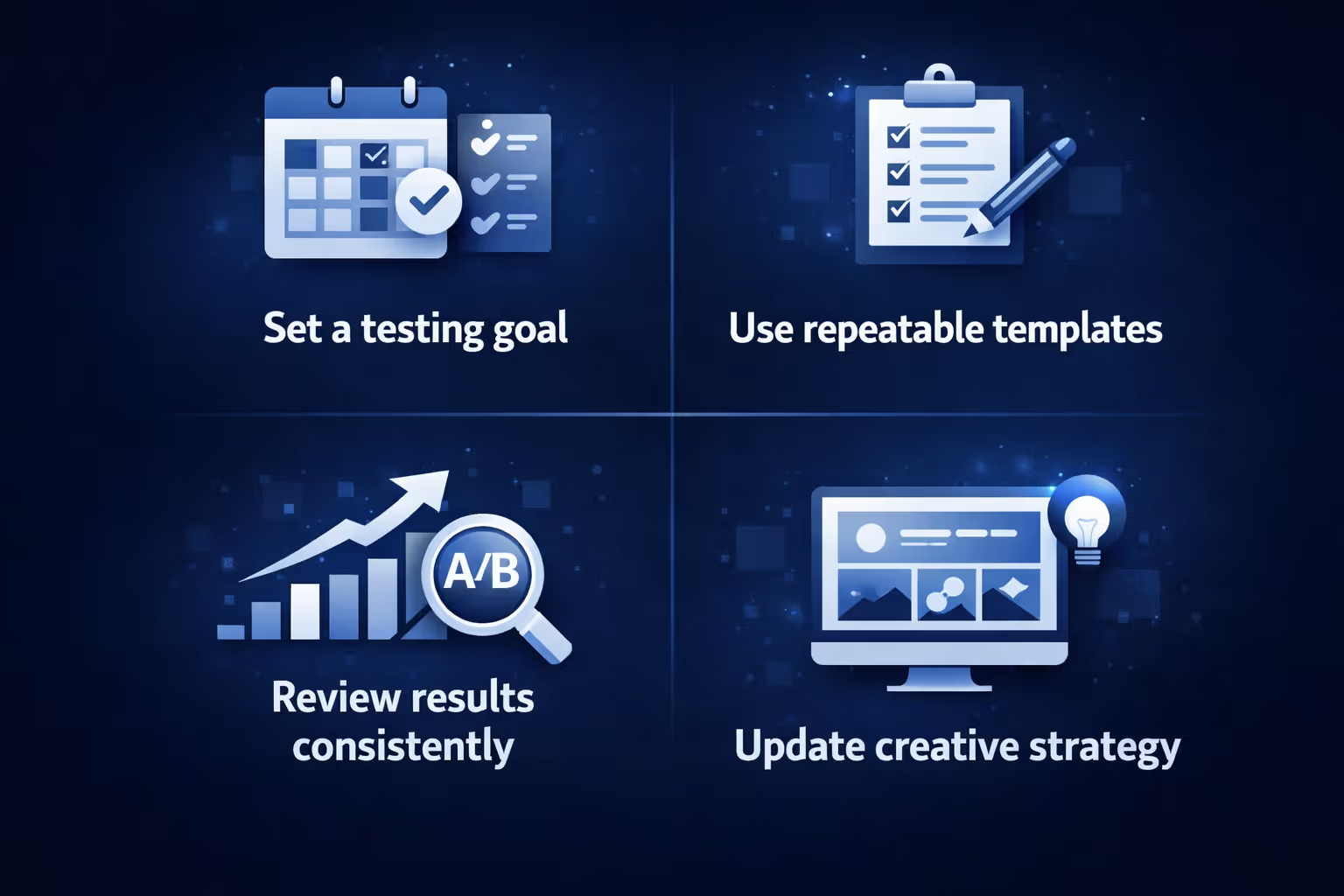
The best-performing Meta advertisers aren’t just good at testing - they do it all the time. It’s part of their workflow, not a one-time project.
Think of it like this: every week you don’t test, you’re flying blind again. The more you treat testing like a normal part of ad ops, the faster you’ll adapt when things shift.
Make it routine by:
If you’re pressed for time, start small. Even one test every two weeks adds up. The trick is consistency.
A/B testing for Meta Ads isn’t rocket science, but it does require discipline. The brands that make the most of it aren’t just running tests – they’re running useful tests, tracking real metrics, and iterating constantly.
Set clear goals, change one thing at a time, give your tests space to breathe, and keep learning as you go. If you treat testing as part of how you operate, not just something you do when things go wrong, you’ll spend less time guessing and a lot less money fixing broken campaigns.
Let your data do the talking. Then act on it.


