How AI Agents Transform Content Marketing in 2026
Discover how AI agents autonomously execute content workflows, reducing production time 96% while scaling output. Real data on ROI, capabilities, and implementation.
Apr 13, 2026



Shopify is often talked about as “the place to start an online store.” That’s true, but it’s also a bit incomplete. Shopify isn’t just one path to income. It’s a toolbox. What you build with it depends on your skills, your time, and how involved you want to be day to day.
Some people use Shopify to sell physical products. Others never touch inventory at all. There are store owners, service providers, developers, designers, affiliates. All of them are making money inside the same ecosystem, just in very different ways.
This article breaks down the realistic ways Shopify can generate income, how each option works in practice, and what to think about before choosing one. No shortcuts, no promises of “easy money.” Just clear paths you can actually evaluate.
Before getting into specific methods, it helps to reframe what Shopify actually is.
Shopify is not just a store builder. It is an ecosystem. It connects storefronts, payments, apps, logistics, marketing channels, and analytics in one place. That ecosystem creates opportunities beyond selling your own products.
You can make money by:
Each path comes with a different level of risk, effort, and skill. Choosing the right one matters more than choosing the fastest one.

As Shopify businesses scale, paid advertising becomes harder to manage and more expensive to get wrong. Testing ideas live and cutting underperformers after the budget is spent slows growth and increases risk. That is the gap we focus on.
At Extuitive, we help Shopify brands predict ad performance before campaigns go live. Our AI models analyze creatives in advance and forecast real-world results using validation against live campaign data and each brand’s historical benchmarks. This allows teams to identify stronger ads upfront instead of relying on trial and error.
By reducing wasted testing and improving alignment between creatives, audiences, and messaging, brands can scale paid growth with more confidence. The result is better click-through rates, stronger return on ad spend, and a more controlled path to growth as ad volume increases.

This is the most familiar option and still one of the most common.
A traditional Shopify store involves sourcing or creating products, listing them, marketing them, and fulfilling orders. This model works well when you have control over your product and can build a clear brand around it.
What matters most here is not the store setup. It is:
Many new store owners focus too much on themes and apps early on. Those details matter later. Early success usually comes from choosing a product that solves a specific problem or appeals strongly to a defined audience.
Margins matter more than volume in the beginning. A smaller store with healthy margins is easier to grow than a high-volume store that barely breaks even.
Dropshipping lowers the barrier to entry because you do not hold inventory. That makes it attractive. It also makes it crowded.
The dropshipping stores that last tend to do a few things differently:
Profit margins are thinner, and competition is high. Dropshipping works best as a system you manage deliberately, not as a shortcut.
Print-on-demand sits between custom products and dropshipping. You design the product, but production and shipping happen only after an order is placed.
This model works well for creators, designers, and niche communities. It reduces inventory risk but still allows brand expression.
The challenge is differentiation. Generic designs rarely perform well long-term. Stores that succeed usually connect the products to a clear identity or audience.
Digital products remove many operational headaches. No shipping. No storage. No physical returns.
Common digital products include:
Shopify supports digital delivery through apps, making setup straightforward.
What matters most here is trust. People buy digital products because they believe the creator understands their problem. That belief is often built through content, social presence, or prior experience.
Digital products work best when they are specific. Broad topics tend to struggle. Narrow solutions convert better.
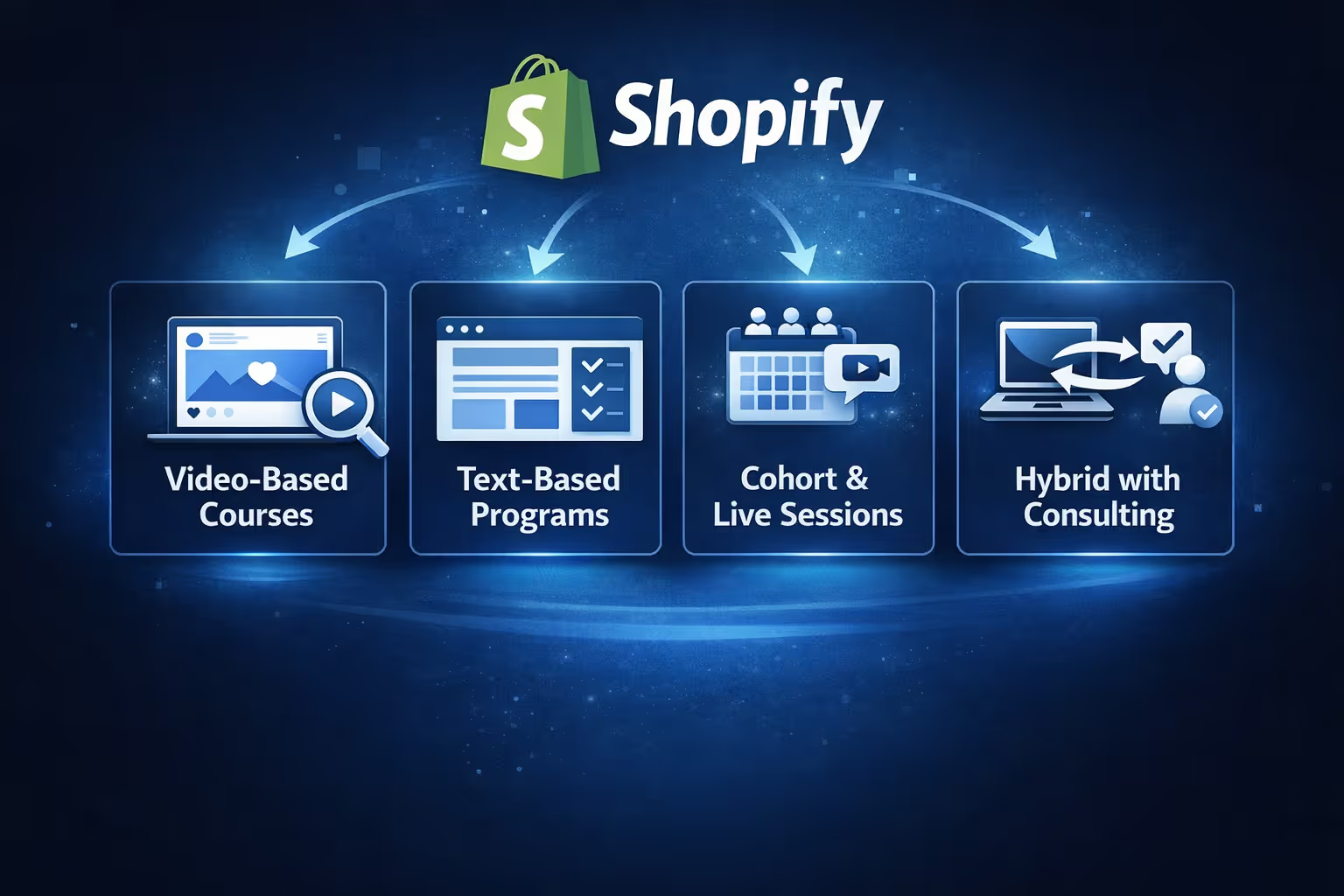
Online courses sit at the intersection of education and digital products. You create the content once, but it can continue to generate revenue over time if it stays relevant and genuinely useful. For people with hands-on experience in a specific area, this can be one of the more sustainable ways to make money with Shopify.
Shopify makes it possible to sell access to different course formats, depending on how you prefer to teach and how your audience prefers to learn.
Selling courses works best when you already have practical experience in a clearly defined area. You do not need a massive audience, but you do need to be specific about who the course is for and what problem it helps solve.
Courses struggle when they try to cover too much at once or aim at everyone. Narrow focus usually leads to better results.
Successful courses tend to share a few core traits, regardless of format.
Shopify handles payments, access control, and product delivery through integrations and apps. That removes a lot of technical friction. What Shopify does not do for you is design the learning experience.
The real work happens in how the course is structured, how lessons flow, and how students are guided from start to finish. A well-organized course with thoughtful pacing will usually outperform a longer, more complex one.
Not everyone using Shopify is selling products. Many are selling themselves.
Shopify can function as a service business website. Designers, marketers, developers, consultants, photographers, and educators all use it to sell services.
Typical service offerings include:
This approach works well if you want predictable income without managing inventory. It also scales through retainers rather than traffic volume.
The key is clarity. Service pages that clearly explain what is included tend to convert better than vague descriptions.
Shopify’s partner ecosystem allows professionals to work directly with merchants who need hands-on help with their stores. Instead of selling your own products, you earn by applying your skills to other businesses that already operate on the platform.
Partners typically work on launching new stores, improving existing setups, solving technical issues, or advising merchants on growth and day-to-day operations. The work varies depending on your background, but it usually involves practical problem-solving rather than creative experimentation.
This path rewards experience and consistency. It is not especially flashy, and it does not promise sudden spikes in income. What it offers instead is stability. Many partners build long-term relationships with clients, which makes this model more predictable than running a product-based store where revenue depends heavily on traffic and demand shifts.
Shopify stores rely heavily on apps. Inventory management, SEO tools, subscriptions, reviews, analytics. The demand is constant.
If you have development skills, building an app can be a powerful way to generate recurring income.
Successful apps usually:
App development takes time upfront, but it can scale well once established. Feedback from real merchants is essential during development.
Themes shape how stores look and function, and for many merchants, they define the first impression customers have of a brand. Store owners usually want designs that feel professional, flexible, and easy to adapt without heavy customization or ongoing development work.
Theme developers can sell their work through Shopify’s official channels or independently. This path requires a mix of front-end development skills, a strong design sense, and close attention to usability. There is also an ongoing responsibility to support updates, fix issues, and keep themes compatible with platform changes.
Themes tend to perform best when they are built for a clear type of business rather than trying to accommodate every possible use case. A focused theme that understands its audience is often more valuable to merchants than a generic option that tries to do everything.
You do not need to run a store to make money around Shopify. Affiliate marketing allows you to earn commissions by referring new users or promoting tools and services connected to the platform.
This approach works particularly well for bloggers, content creators, educators, and influencers who already publish helpful material for a defined audience. The key factor is trust. People are far more likely to act on recommendations when those suggestions feel relevant and genuinely useful rather than forced or overly promotional.
Affiliate income depends less on sheer traffic volume and more on consistency and credibility. Smaller audiences with strong engagement often outperform larger ones where the connection is weaker. When promotions are integrated naturally into educational or practical content, they tend to convert better and feel less intrusive.
If you already have an audience, Shopify can serve as the commerce layer that supports your work. Instead of building a business from scratch, you are offering products or access to people who already know and trust you.
Creators commonly use Shopify to sell branded merchandise, digital products, exclusive content, or access to private communities. This model works best when the products feel like a natural extension of the content rather than a separate sales effort.
Audience trust is fragile, and monetization can quickly backfire if it feels disruptive. The most sustainable approach is to offer something that clearly adds value and fits seamlessly into the existing relationship, rather than interrupting it.
Once a store starts getting consistent traffic, optimization becomes more important than adding new features or products. At this stage, small improvements in how visitors move through the site can have a noticeable impact on revenue.
Common issues that hold stores back include:
Tools that support personalization, testing, and visitor segmentation can help address these problems, but only when they are used with a clear purpose. Pop-ups, for example, can recover abandoning visitors or highlight relevant offers, but only if the timing and message make sense for the situation.
The goal is not to stack more tools onto the store. It is to reduce friction. In practice, a few well-placed changes, clearer copy, or better page structure often outperform complex setups that try to do too much at once.

Scaling is where many Shopify-based businesses start to feel real pressure. What worked at a smaller size often begins to break once order volume increases, expectations rise, and mistakes become more expensive.
As a store grows, new problems tend to surface quickly. The most common ones include:
These issues are normal, but they can slow growth if they are not addressed early.
Scaling works best when systems are built ahead of demand rather than in response to emergencies. Clear processes for fulfillment, support, and marketing make growth easier to manage. Realistic forecasting helps avoid overextending resources, while steady, incremental improvements tend to be more sustainable than aggressive expansion.
Many Shopify users struggle not because the platform fails them, but because their expectations are out of sync with how online businesses actually grow. Shopify lowers technical barriers, but it does not remove the need for planning, testing, and patience.
Common mistakes that limit earnings include:
Avoiding these mistakes often has a greater impact on long-term results than finding a perfect product or clever tactic. Solid fundamentals tend to outperform quick wins over time.
Shopify is not a shortcut to income. It is infrastructure.
When used thoughtfully, it can support many types of businesses, from solo projects to large operations. The most successful users tend to focus less on hacks and more on fundamentals.
Clear value. Consistent effort. Real problems solved for real people.
That is what actually works.


