Best Facebook Ads Agencies in Perth for Growing Businesses
Looking for a Facebook Ads agency in Perth? Discover trusted agencies helping local businesses run smarter Meta campaigns and grow faster.
Mar 22, 2026



Facebook ads are no longer about clever tweaks inside Ads Manager. In 2026, optimization is about systems, signals, and knowing when to step in instead of letting automation drift. Costs rise fast when creatives burn out, data gets noisy, or campaigns are scaled without a plan.
This article breaks down Facebook ads optimization strategies that actually hold up today. No tricks, no recycled playbooks. Just clear thinking around structure, creatives, bidding, and feedback loops that help campaigns stay profitable as they grow.
Most Facebook Ads “optimization” starts after the budget is already gone. You launch, you spend, you wait for signal, then you fix what broke. That loop used to be workable. Now it is slow, expensive, and honestly a little backwards.
At Extuitive, we built a prediction engine to answer the question that matters earlier: which creatives are most likely to drive higher CTR and stronger ROAS before launch. Predictive advertising uses real data and modeled consumer behavior to estimate how a creative will perform before it goes live. Instead of guessing what might work, teams get a clear signal on what to launch, what to pause, and what to refine. The result is fewer wasted test campaigns, more focused creative decisions, and more budget going to ads that are more likely to earn attention and convert.
Instead of treating every campaign like a fresh experiment, we turn your past winners and losers into a usable decision system.
Here is Extuitive does in practice:
The goal is simple: fewer losing launches, faster creative decisions, and a cleaner path to consistent CTR and ROAS. In a world where platforms are more opaque and feedback loops cost more than they used to, prediction is not a nice-to-have. It is how you stop paying for “learning” that never carries forward.
A messy account can hide problems for weeks. A clean one makes issues obvious within days.
Structure controls how data flows, how learning consolidates, and how easy it is to diagnose performance drops. No bidding strategy or creative angle can compensate for a structure that fragments signals.
Older playbooks favored heavy segmentation. Separate campaigns for every audience, placement, and creative idea. That approach often slows learning today.
A more durable setup looks like this:
The goal is not minimal structure. It is intentional structure. Every split should have a reason.
Choosing the wrong objective does not always tank results immediately. It quietly trains the algorithm on the wrong behavior.
Traffic campaigns find clickers, not buyers. Engagement campaigns optimize for reactions, not revenue. Even lead campaigns can skew toward low-quality volume if downstream signals are missing.
Pick the objective that aligns with the most reliable signal you can send.
Optimization begins before the first impression is served.
Facebook can optimize only what it can actually see. When signals are weak or incomplete, the algorithm fills in the gaps with models and assumptions. That is when delivery becomes unstable, costs drift upward, and scaling turns unpredictable.
Signal loss is not a future threat. It is the default state in 2026. Browser privacy changes, shorter attribution windows, and opt-outs mean you are always working with partial visibility. Optimization today is less about perfect data and more about making the best possible signals available.
Relying on browser-based tracking alone is no longer enough. Pixels miss events, drop identifiers, and break under modern privacy restrictions. Server-side tracking helps recover part of that lost visibility and smooths out gaps in reporting.
The most reliable setup combines both approaches. The browser pixel captures real-time user behavior as it happens, while server-side events backfill missed conversions and identifiers. This redundancy stabilizes signals and gives the algorithm more consistent feedback, especially during scaling or high-volume periods.
A conversion event without context is a weak signal. Sending only a purchase or lead flag tells Facebook that something happened, but not who it happened to or how valuable it was.
Stronger events include meaningful identifiers, consistent click and browser IDs, and accurate conversion values with timestamps. The more complete the event payload, the easier it is for the algorithm to match users, learn patterns, and optimize delivery with confidence.
Many ad accounts still optimize around outdated event structures. Page views, generic leads, or shallow actions often remain prioritized simply because they were set up years ago.
Optimization improves when events reflect actual business value. Purchases matter more than add-to-cart actions. Qualified leads matter more than raw form submissions. Composite events that capture real intent consistently outperform long lists of weak signals.
Fewer high-quality events give the algorithm clearer direction than many low-impact ones.
Event match quality directly affects delivery. Better matching allows Facebook to connect events to real users more reliably, which improves optimization and reduces wasted spend.
Passing hashed emails and phone numbers when possible, including fbp and fbc parameters consistently, and validating event payloads to avoid missing or malformed fields all contribute to stronger matching. Even small improvements here can have an outsized effect on CPMs and conversion efficiency, especially in performance-focused campaigns.
Most Facebook campaigns do not fail because of bidding mistakes or broken targeting. They fail because the message gets old. Audiences see the same idea too many times, stop paying attention, and performance slowly slips away.
Creative fatigue rarely announces itself in dramatic ways. It shows up as small, gradual changes that are easy to ignore until results are already compromised:
By the time most teams react, the algorithm has already adjusted delivery, audiences are saturated, and recovering performance requires more than a simple creative swap. Treating creative as the main growth lever means watching these signals early and planning refreshes before fatigue fully sets in.
High-performing teams plan for decay. They assume creatives will expire, lose attention, and eventually stop converting. Instead of chasing a perfect ad, they build systems that make replacement easy and predictable.
This mindset shifts creative work from one-off production to ongoing renewal.
Practical habits that support this approach include:
The goal is not endless testing or chasing novelty. It is controlled renewal. When creative rotation is planned and systematic, performance stays stable and scaling becomes far less fragile.
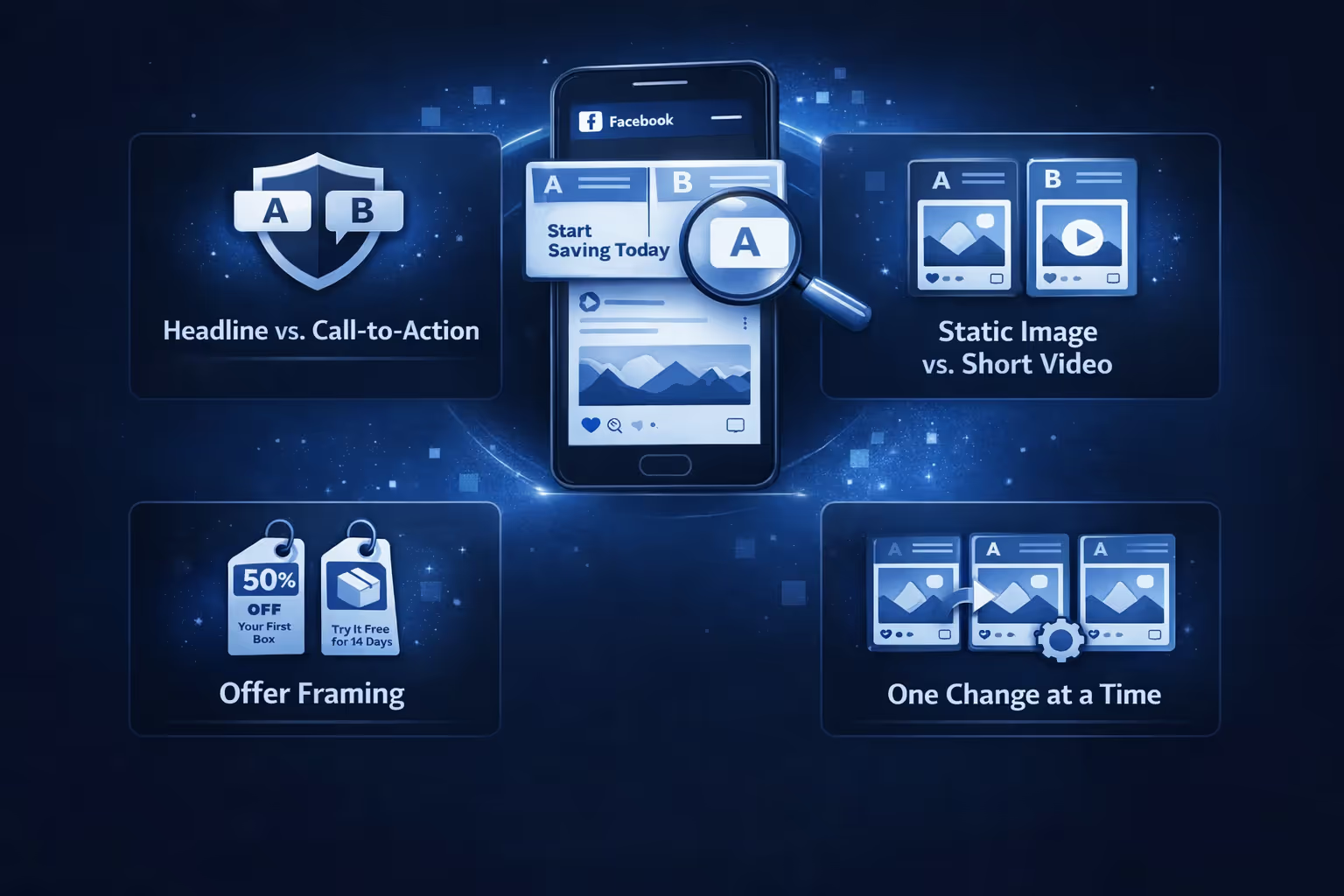
Most creative testing wastes budget because too many variables are changed at the same time. When audiences, messages, formats, and offers all shift together, results become noisy and hard to trust. Performance may change, but it is rarely clear why.
A cleaner approach focuses on one learning goal at a time. Each test should answer a single question. That might mean running one campaign where the audience stays the same while creatives change, or keeping the creative constant while testing a new hook. Sometimes the offer shifts while everything else remains stable. The point is to isolate the variable that actually drives performance.
Tests work best when they are small, fast, and deliberate. Learning speed matters more than test volume. A few focused experiments that produce clear insights will outperform a large number of unfocused tests that only create confusion.
Automation is now the default in Facebook Ads, not an optional feature. The mistake many teams make is treating it as a complete replacement for decision-making. In reality, automation works best when it handles execution, while humans stay responsible for direction and judgment.
Automation shines when:
In those conditions, automated placements and budgets can outperform manual control.
Manual control still matters when:
The best setups use automation for execution and humans for direction.

Large budget jumps reset learning and increase volatility. Performance drops are often blamed on fatigue or competition when the real issue is pacing. When spend changes too quickly, the system has to re-stabilize delivery, and you often end up paying more to relearn what you already had working.
Scale in controlled steps rather than big leaps. Smaller increases keep the learning system steady and reduce the chance of sudden CPA spikes. If results hold after an increase, you earn the right to scale again.
More conversions is not automatically good growth if costs rise faster than revenue. Track whether marginal performance is staying within acceptable bounds. If volume climbs but efficiency drops, that is not scale, it is drift.
Every campaign hits a point where extra budget buys lower-quality inventory. When you see diminishing returns, stop increasing spend and stabilize. Sometimes the next step is not more budget - it is new creative, new angles, or stronger signals.
Prospecting and retargeting behave differently and break for different reasons. Keep them separate so you can scale prospecting without starving retargeting, or protect retargeting efficiency without limiting growth.
Scaling is not about spending more. It is about spending more without losing control.
Broad targeting can outperform interest stacks, especially when creatives are strong and signals are clean. But broad does not mean careless. Without basic guardrails, delivery can drift into low-quality traffic that looks fine in volume but performs poorly in value.
At the same time, the highest-performing audiences rarely come from platform guesses alone. They are built from real business data and real outcomes.
Your best audiences are built from:
The algorithm performs best when it is trained on real behavior, not assumptions.
Data in Facebook Ads is increasingly modeled, and that is now the norm rather than the exception. Attribution windows are shorter, conversions are estimated, and delays are built into reporting. Treating this as a temporary issue only leads to frustration and over-optimization.
Performance is easier to manage when you adjust how results are interpreted. Instead of reacting to absolute numbers, compare relative performance between campaigns and ad sets. Look for trends over time rather than day-to-day swings. For lead-based funnels, delayed validation often gives a more accurate picture of effectiveness. Reporting should also match funnel length, since short windows rarely reflect true value.
Trust patterns, not spikes. This shift in mindset reduces unnecessary changes and leads to steadier optimization decisions.

Most performance drops have a cause. The real challenge is identifying which one before small issues turn into expensive ones. Reacting too quickly often leads teams to change multiple variables at once, making it harder to understand what actually went wrong.
Optimization works best when you slow down just enough to isolate the signal.
If click-through rate declines while CPM remains steady, the problem is rarely targeting or bidding. This pattern almost always points to creative fatigue. The audience is still available at the same cost, but fewer people are engaging with the message.
In this case, the fix is not structural changes or budget adjustments. It is a creative refresh, usually starting with new hooks or angles rather than entirely new formats.
A rising CPM with stable CTR usually signals auction pressure or declining signal quality. Competition may be increasing, or the platform may be struggling to confidently match events to users.
Before touching creative, check signal health. Event match quality, missing parameters, or server-side tracking issues often explain this pattern better than creative changes.
When cost per acquisition increases while conversion volume remains stable, attribution is often the culprit. Modeled data shifts, delayed conversions, or changes in downstream value can distort short-term performance.
In these situations, avoid immediate cuts. Look at delayed windows, compare relative performance, and confirm whether value is actually declining or simply arriving later.
Optimization starts with asking the right question, not changing five things at once.
High-performing Facebook Ads accounts do not run on urgency. They run on rhythm. When review cycles are consistent, problems are spotted early and addressed calmly, before they turn into expensive emergencies. This approach replaces reactive decision-making with steady, informed optimization.
Simple routines that support this system include:
Consistency in review prevents panic optimization. When feedback loops are built into the workflow, decisions become proactive instead of reactive, and performance remains far more stable over time.
The most profitable Facebook Ads accounts rarely look exciting from the inside. They rely on systems rather than constant experimentation and trade novelty for predictability. What looks uneventful day to day is often a sign that the foundation is working.
Optimization strategies that drive consistent growth are not secret or complex. They are disciplined. Clean structure keeps learning efficient. Strong signals give automation something reliable to work with. Planned creative rotation prevents fatigue before it becomes visible. Measured scaling protects momentum. Clear diagnostics remove guesswork when performance shifts.
Facebook Ads will keep changing. Automation will get smarter. Data will get noisier. The fundamentals still hold. Build a system that respects that reality, and growth becomes repeatable instead of fragile.
Facebook Ads optimization in 2026 is less about constant action and more about controlled decision-making. The accounts that grow consistently are not the ones making the most changes, but the ones making the right changes at the right time. They rely on structure, clean signals, creative discipline, and feedback loops instead of reacting to every fluctuation in Ads Manager.
When optimization is treated as a system rather than a series of fixes, performance becomes easier to understand and easier to scale. Volatility drops, learning speeds up, and growth feels steadier instead of fragile. Facebook Ads will continue to evolve, but the principles that support consistent results remain the same. Build around those principles, and optimization stops feeling like a constant firefight.


