The Best Facebook Ads Optimization Tools Marketers Actually Use
A practical look at Facebook ads optimization tools - what they do, how they help, and which platforms marketers use to get better performance.
Feb 4, 2026



Facebook ads haven’t become harder because marketers forgot how to run campaigns. They’ve become harder because the rules quietly changed. Less signal, more automation, tighter attribution, and platforms that now do a lot of thinking on your behalf.
Optimization in this environment isn’t about constant tweaking or chasing the next tactic. It’s about knowing which levers still matter, which ones are noise, and when doing less actually leads to better results. The brands that win aren’t testing more, they’re testing with intent, protecting signal quality, and making decisions earlier in the process.
This article breaks down what Facebook ads optimization really means today, and how to approach it in a way that saves budget, reduces blind spots, and leads to steadier performance over time.
We built Extuitive for e-commerce brands that want to know which ad creatives are most likely to perform before spending media budget. Instead of relying on trial-and-error testing, we shift paid media from experimentation to prediction.
We analyze your historical brand-level performance data and combine it with large-scale consumer intelligence to forecast creative outcomes ahead of launch. That helps teams spot high-potential ads early, cut weak assets before they drain budget, and focus spend on creatives with a higher probability of strong CTR and ROAS.
Our system is contextual by design. We train a custom perceptual model for each brand using its own best and worst-performing ads. That means the same creative can receive different predictions depending on brand, audience, and historical performance patterns.
As your ads run, we keep learning. We monitor prediction accuracy, detect shifts in audience response, and refresh models over time. The result is a living intelligence layer that captures what works, what does not, and why - so creative learnings become reusable across campaigns instead of resetting every launch.
Facebook Ads optimization works best when it follows a clear logic. These ten tips reflect how strong accounts are actually run today, based on signal quality, structure, and disciplined decision-making.
Most Facebook Ads problems are diagnosed at the creative level, but the root cause often sits deeper. If Facebook cannot clearly understand what success looks like, no amount of testing will fix performance.
Facebook optimizes toward what it can reliably observe. When tracking is incomplete, delayed, or inconsistent, the system starts optimizing toward proxy behaviors that look good on paper but fail to produce results.
This is why two accounts running similar creatives can see very different outcomes. One is training the algorithm with clean, meaningful data. The other is asking Facebook to guess.
Strong signal is not about tracking everything. It is about tracking the right things, consistently.
In most high-performing accounts, this includes:
When signal quality improves, optimization becomes calmer. Results fluctuate less, learning stabilizes faster, and decisions become easier to trust.

Not all conversions deserve the same importance. Optimizing for the wrong event can create the illusion of progress while revenue stays flat.
Facebook will happily deliver cheap conversions if that is what you ask for. The problem is that low-effort actions often attract low-quality users. Clicks, page views, or basic form fills may increase volume, but they do not necessarily signal real buying intent. When campaigns optimize around these actions, performance downstream almost always suffers.
High-impact conversion events tend to sit close to revenue or a meaningful business outcome. They also need to occur often enough for the algorithm to learn, while still representing deliberate intent rather than casual curiosity. The goal is not to find the perfect event, but to strike a balance between quality and frequency that allows Facebook to optimize efficiently.
For lead generation, raw form submissions are often a weak optimization signal. Many businesses see stronger results when optimization moves closer to qualification. Training campaigns on leads that passed internal scoring, demo requests that met clear criteria, or meaningful follow-up actions after submission gives Facebook clearer feedback on which users actually matter.
When the algorithm receives better signals, delivery improves without requiring higher budgets.
Account structure quietly determines how fast Facebook learns. When campaigns are too fragmented, data spreads thin, learning resets more often, and performance becomes harder to diagnose. A simpler structure concentrates signal and gives the algorithm clearer direction.
Consolidated campaigns tend to work best when:
Over-segmentation usually does the opposite. It fragments data, prolongs the learning phase, and increases the likelihood of unstable results.
Segmentation is useful, but only when it is justified. Splitting campaigns without a clear reason often slows learning and makes optimization harder than it needs to be.
Separating campaigns works best when differences are real and meaningful. Clear examples include distinct funnel stages, materially different offers or pricing, or creative angles that speak to different types of intent. In these cases, segmentation helps align messaging, measurement, and delivery instead of fragmenting data.
Segmentation becomes a problem when it exists mainly to create control. Splitting audiences, creatives, or placements without a strong behavioral reason spreads signal too thin and increases learning resets. The result is slower optimization and less reliable performance.
Optimization is not about choosing consolidation or segmentation forever. It is about knowing when each approach supports learning and when it quietly works against it.
Campaign objectives shape delivery more than most settings inside Ads Manager. Once an objective is chosen, Facebook optimizes every decision around it, from who sees the ad to how often it appears. If that objective does not match real user intent, performance will drift even if everything else looks correct.
Before launching, it helps to be explicit about the action you want users to take, which event best represents that action, and whether that event occurs often enough to train the system reliably. Objectives that sound right but lack volume or intent often lead to unstable results.
Choosing the wrong objective is one of the hardest mistakes to fix later. Once spend ramps up and learning settles in, changing objectives usually means starting over, which makes early clarity especially valuable.
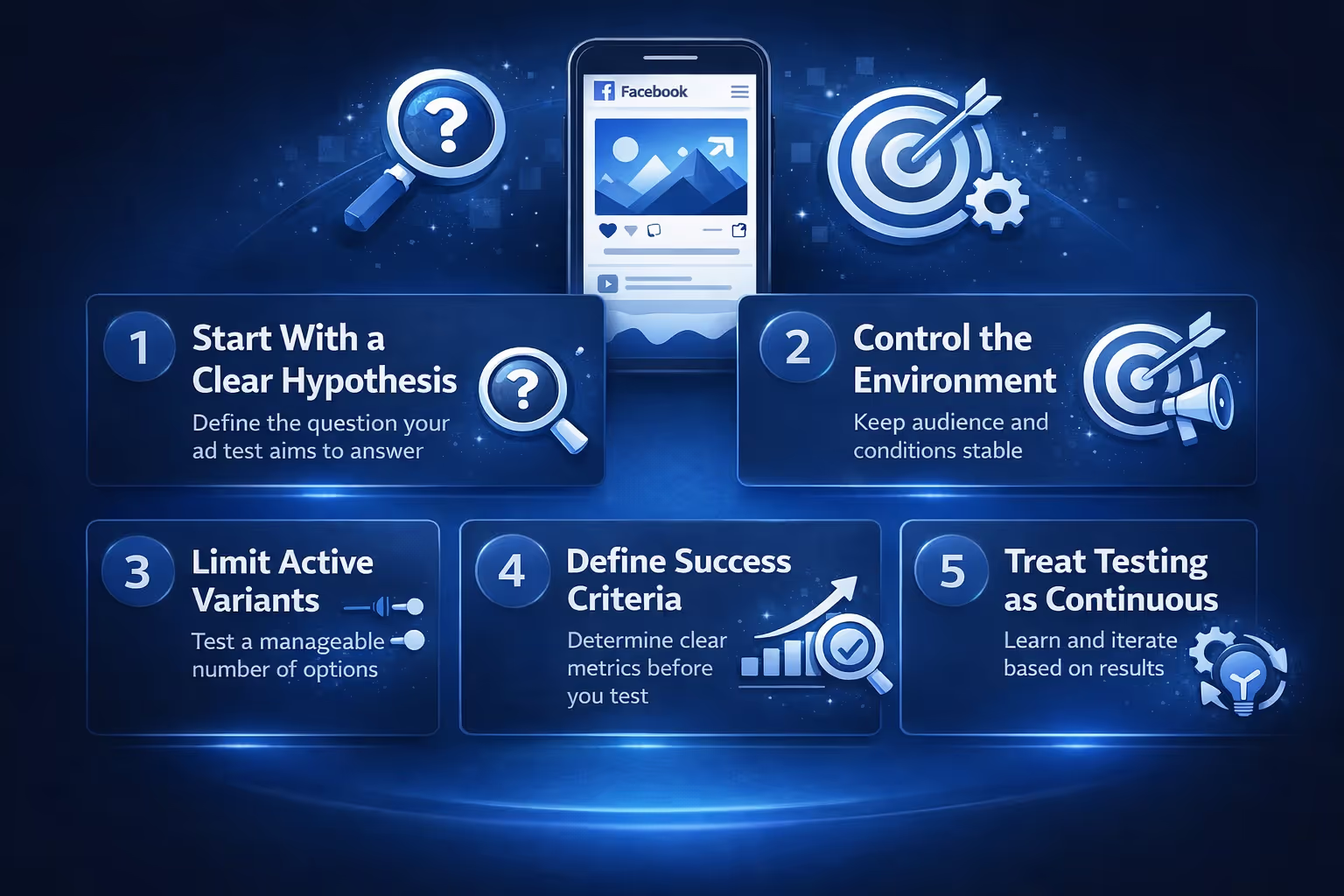
Creative testing should generate insight, not noise. When too many ideas run at once, results blur together and optimization becomes reactive instead of deliberate.
Every test should begin with a specific question. That question might be about a hook, a value proposition, a visual style, or the tone of the message. Without a clear hypothesis, performance differences become anecdotes rather than evidence.
A single, focused idea gives the test direction and makes outcomes easier to explain and reuse.
Creative tests only make sense when the surrounding conditions stay stable. Running variants against the same audience, under the same objective, and within the same time window reduces noise that has nothing to do with the creative itself.
When audience, budget, or bidding shifts mid-test, results lose meaning even if numbers look decisive.
More variants do not mean better learning. In most cases, a small number of well-designed options outperform a large set of loosely differentiated ads. Too many variants dilute delivery, slow learning, and make it harder for any single creative to get enough signal.
Fewer variants allow Facebook to allocate impressions more efficiently and surface real differences faster.
Deciding what matters after a test ends often leads to biased conclusions. Clear success metrics should be set before launch, whether that is CTR, cost per qualified action, or downstream conversion quality.
When success is defined in advance, optimization decisions feel less emotional and more repeatable.
Creative testing is not a one-off task. High-performing teams treat it as an ongoing system where learnings feed the next round. Winning elements are reused, adapted, and refined rather than discarded after a single cycle.
Random testing creates movement. Disciplined testing creates momentum.
Creative performance rarely collapses overnight. In most cases, it fades gradually, and the early warning signs are visible long before results fall apart.
CTR often softens first, even while CPM remains stable. Over time, frequency increases, engagement weakens, and conversions begin to slip. Waiting for a clear failure usually means paying more to recover than necessary.
Teams that track these patterns and rotate creatives proactively tend to maintain steadier performance. By acting before fatigue becomes obvious, they avoid sharp declines and reduce the pressure to constantly launch entirely new concepts.
Different ad formats age at different speeds, and treating them as interchangeable often leads to uneven performance. A format that works well in one part of the funnel can underperform badly in another.
Static images tend to fatigue fastest, especially when shown repeatedly to the same audience. UGC-style videos usually hold attention longer because they feel less like ads and more like organic content. Narrative-driven creatives, such as founder-led videos or short stories, often decay more slowly because viewers engage with the message rather than just the visual. Carousels can perform well when each card adds context and the story unfolds naturally.
Formats often perform best when they are matched to a specific role, such as:
Optimization is not about finding a single winning format and using it everywhere. It is about aligning format with funnel stage, user intent, and how long that format is likely to stay effective.
Bidding rarely creates performance on its own. Its real job is to protect results that already exist. When bids are set correctly, they prevent costs from drifting, keep delivery stable, and reduce the chance of sudden performance swings. Treating bidding as a shortcut to growth usually leads to volatility rather than scale.
Automated bidding works best when conversion volume is stable, signal quality is strong, and scaling is the main objective. In those conditions, Facebook has enough information to make efficient decisions. Manual or goal-based bidding still plays an important role when CPA limits are strict, auctions are volatile, or testing requires tighter control. The key is not choosing one method forever, but adjusting the level of control based on how predictable the system actually is.

Fast reactions feel productive, especially when numbers dip. Correct reactions drive results. The difference between the two is diagnosis. Acting without understanding the cause often creates more instability than the original problem.
When performance drops, the instinct is to adjust budgets, swap creatives, or change targeting. These moves may temporarily shift metrics, but they also reset learning and introduce new variables. Without diagnosis, it becomes impossible to tell whether results improved because of the change or in spite of it.
Strong optimization slows down just enough to understand what is actually moving.
Metrics rarely change in isolation, and the relationship between them usually tells a clearer story than any single number.
A CTR decline with stable CPM often points to creative fatigue rather than audience or bidding issues. A sudden CPM increase without structural changes usually reflects auction pressure or weakened signal. When ROAS falls while CTR holds steady, the issue often sits in conversion quality, tracking, or attribution rather than in the ad itself.
Looking at these patterns together helps narrow the problem before taking action.
Effective diagnosis means changing one thing at a time. Before making adjustments, it helps to ask what changed first and which metric moved in response. That discipline keeps optimization focused and prevents cascading edits that mask the real cause.
Strong optimization isolates the variable, confirms the hypothesis, and then acts with intent. Over time, this approach reduces unnecessary changes and makes performance more predictable.
Facebook Ads optimization no longer rewards constant movement. The days of endless tweaks, rapid-fire tests, and reactive fixes are largely over. What works now is clarity. Clear signal, clear structure, clear intent behind every decision.
The strongest accounts are not doing more. They are guessing less. They focus on feeding Facebook better information, simplifying how campaigns learn, testing creatives with purpose, and diagnosing problems before reacting to them. Optimization becomes less about chasing short-term wins and more about building a system that compounds learning over time.
When optimization is treated as a process instead of a set of tricks, performance becomes steadier, budgets work harder, and decisions feel more predictable. That is how Facebook Ads improve without guesswork.


